
CHAPTER IV
WONIGKEIT AND IRMISCH ARE CONVICTED OF MURDER AND ARE HUNG — SALARIES OF OFFICERS — CHIEF GOSS PROVES AN EFFICIENT HEAD OF THE DEPARTMENT — POLICE PENSION LAW IS REPEALED — TALES OF CRIMES AND ARRESTS — EXTRACTS FROM THE CHIEF'S REPORT FOR 1898 — BIOGRAPHIES OF THE OFFICERS AND MEMBERS OF THE DEPARTMENT — INTERESTING NARRATIVES OF POLICE LIFE — ENGRAVINGS OF THE BEST MEN ON THE FORCE.
The value of life to be fitly determined must not be estimated by the number of years we have lived but by the aggregate amount of happiness we have been able to take out of those years. As with a citizen, so with a city, the one which has longest given its denizens comfort and quiet must be perforce a better place to live in than the ancient borough in which the voice of improvement is never heard. But for the very reason that the youngest cities of the world are the most progressive they often attract a heterogeneous population for whose deeds no municipal responsibility can be fixed. It is so with St. Paul and was much more so during the years of 1893 and 1894. Few real criminals have been of native birth; rarely has Minnesota had occasion to be ashamed of her own sons.
For the extremely large number of lawless characters infesting St. Paul immediately after the World's Fair in Chicago no other cause than the fair can be assigned. And yet it would doubtless be a great injustice to blame a gala occasion in Chicago for a double hanging which occurred in St. Paul, despite the fact that the hanging was a direct outcome of existing conditions.
It was during the last month of Mayor Wright's administration. All the "bunco" men had "steered" into the workhouse, all the suspects with a highway robbery air had been either jailed or ordered to leave town, and Chief Garvin was breathing just a little bit more freely when the rumor of an atrocious murder rent the air.
A barkeeper named Wm. Lindhoff had been shot and killed almost instantly in a saloon on the corner of College av. and Wabasha st. Only one man was in the place at the time. A woman, Mrs. Kohlmann the wife of the proprietor, sat at a table near the rear entrance. She was engaged in conversation with Lindhoff — it was a little after 9 p. m. — and the evening as quiet and balmy as only evenings in early May can be. Suddenly the front and side doors, both leading to the street, opened with a jar. Two men entered — boys they seemed to the startled eyes of the woman and the one lone visitor — and moving rapidly towards the bar called out "Hands up!" at the same time pointing their revolvers at Lindhoff. Too frightened to stir from her seat, Mrs. Kohlmann cried out, "Willie, get your revolver! These men are robbers." At this one of the men turned on her, menacing her with his weapon as she ran down the length of the saloon, entreating the protection of the barkeeper. Why the one man present, afterwards subpoenaed as an eye witness, did not make an effort to defend her, has never been quite plain. On hearing the barkeeper called upon the robbers both began firing at Lindhoff, or Linhoff, wounding him several times. According to Wonigkeit's confession seven shots were fired, meeting with only one at the hands of the murdered man. Lindhoff died soon after reaching the city hospital, and though Mrs. Kohlmann's evidence was valuable as that of an eye-witness, it did not furnish a clue, being the faces of both robbers were completely disguised by large red and white handkerchiefs. The corraling of the two boys who were soon to figure as examples of extreme justice is really very creditable to the four detectives employed in working out the case, Chief McGinn, "Jack" McGuiggan, "Jim" Werrick and Henry Gruber. McGuiggan, it seems, had found their methods almost identical to those employed by two men who had robbed a till in a W. 7th st. saloon and because of their youth confined in the St. Cloud reformatory. On looking up the records of Wonigkeit, alias Millhausen, and Irmisch, he became convinced that they were the murderers. and found his suspicion fully verified when Wonigkeit, caught while loitering with a tough gang on the levee, confessed in detail.
On seeing Lindhoff fall to the floor the two boys thought only of escape; all dreams of ill-gotten gain vanished with the fear of capture and punishment, and as a consequence the condition of the money drawer puzzled many who tried to guess at the motive of the murder. Running up College av. in a headlong fashion, they turned into Aurora av. and found shelter for the night on the hay of the Merriam barn. At 5 the next morning they made their way to the railroad tracks and followed the ties until they reached Red Rock. For three days and three nights they occupied a deserted shanty in the vicinity of the Methodist camp ground, begging food at surrounding farms and calling themselves Fisher and Squires. On Sunday morning Irmisch had so far succumbed to wet and cold and hunger as to feel the necessity of going home to his mother on Blair st., and there the city physician found him and handed him over to the police. He was suffering with acute pneumonia and could not be removed for a week afterward. In the meantime Wonigkeit confessed, and from the first both boys seemed to feel that it was all over with them. They had a fair, though a short trial and a verdict of murder in the first degree was brought in. That meant hanging.
They certainly deserved it. But how many other guilty men and women, also, older, wiser and, therefore, far more culpable than those two foolish wretches, born criminals though they may have been, have not escaped their fate, aye, even escaped a semblance of punishment. After all, how near we are to civilization with a record of a half-crazed Indian, a friendless woman, and — two boys, neither of them over twenty, swung into eternity by the justice of a Saint.
"I and Charlie Irmisch were without money and had no means of getting any, so we made up our minds to rob the bartender of Kohlmann's saloon."
That was the only plea entered, the plea of a degenerate. Friday, Oct. 19, 1894, at 5:05 a. m., just as the first rays of daylight were beginning to creep through the cell windows, it was answered by Sheriff Chapel. Side by side they passed out of the life in which they had so much in common — Otto Wonigkeit and Charles Irmisch — badly born, badly reared and badly entering into an unknown court of final judgment.
As proof of Irmisch's inherited criminality, Mrs. Henrietta Schmelzer, his mother, occupied a cell in the jail on the morning of the hanging. She had been found guilty of handing him a pistol wherewith to shoot the deputy sheriff, Edward Horst, some six weeks before and loudly bewailed the "cruelty," which had kept her from her son in his last moments. But hardly had two years passed before she herself was sent to Stillwater for outrageous treatment of a little step-daughter.
Just three months before the murder of Lindhoff, on Feb. 1, 1894, an extremely popular young butcher named Martin Erickson, had been brutally killed in his shop at 540 Decatur st. Nine o'clock was also chosen as the hour of reckoning. But this murder was evidently the result of a quarrel. Various suspects from "Swede Hollow" and "Connemara Patch" were lodged behind bars, but to no avail. Though seen by a brother and a friend of Erickson in his mad rush for liberty, after the commission of the deed, the assassin is still at large, and poor Erickson has long since joined the lists of the unavenged.
Mayor Robt. A. Smith entered upon his second term of office in June, 1894, and Hon. Grier M. Orr became one of the municipal judges in May, In July St. Paul and Minneapolis experienced the first railroad strike, in fact the first strike, of any magnitude which has ever threatened to disrupt the local world of capital and labor. It passed over without serious riot or bloodshed, however, and the credit accruing from this circumstance has been generally ascribed to the vigilance of the Twin City police force. During the time of disorder, according to Chief Clark's report, 1,852 days of extra police duty were performed in St. Paul. Chief John Clark and Chief of Detectives O'Connor were reinstated in office with the change of administration, and so vigorous were the methods used to rid the city of unwelcome guests in those days that it is said 1894 witnessed the departure of an army of confidence men and the closing of every "bunco" establishment in sight.
In 1895 the census report showed St. Paul to have a population of 140,292.
Local crime, according to Chief Clark's report, decreased fifty per cent during this year, and to John J. O'Connor with his staff of experienced detectives, Thos. Horan, Thos. Kenaley, M. H. Daly and D. L. Ahern, the credit for this condition of affairs is largely given.
Only one murder attracted public attention in 1895, and that was the death of Clara Berg at the Globe hotel. A doctor, John Johnson, of Wisconsin, was sent to Stillwater for malpractice.
Police salaries in 1895 were as follows: Chief, $3,500; captains, $1,400; lieutenants, $1,200; mounted lieutenants. $1,460; sergeants, $1,000; mounted sergeants, $1,260; chief of detectives, $2,000; detectives, $1,200; patrolmen, $900: mounted patrolmen, $1,160; matron, $600.
When the investigation committee, which was in daily session from Oct. to Dec. 4 of that year, made their report they recommended a number of retrenchments, one of them being a reduction in the salaries of patrolmen. Seventy-two dollars and fifty cents a month became the rate in April, 1896 a further cut to $70, the present salary, was made in September.
On Thursday night, May 21, 1896, there were three hold-ups and the two perpetrators were cleverly intercepted by Detective Enright and Officer McHale, the latter in citizen's clothes, who came upon them lying in the grass on Hague av. and Avon st. "What are you doing here?" said McHale. Putting up his gun, one of the robbers replied, "None of your business," and would have fired but for catching sight of two men behind the officers. The two, Fred Whitaker, alias Hill and Harry Wiman, alias Harris, was promptly jailed and given the full limit of the law. Whitaker has since asked for a pardon, but to no avail. Their capture was the final breaking up of a gang of thieves who had terrorized the Twin Cities for years.
The summer of 1896 was marked by an attempt at murder so peculiar as to elicit much attention at home and abroad. An expelled minister of the gospel was involved. His name was J. C. Hull, and he lived in West St. Paul. He had long known his wife to be suffering from a well nigh incurable disease, but managed, nevertheless, to have her life insured in his favor. Waiting for a natural death proved unsatisfactory and he began giving Mrs. Hull minute doses of arsenic with her medicine. His bedside devotion was such as to allay all suspicion on her part for some time, but finally she unearthed an attempt upon her life which filled her with horror of the man who was her husband. He was arrested on Aug. 5.
When Hull was put on trial his attorney, Mr. Pierce, believing him innocent, so skillfully brought out facts in his defense as to make his release seem sure. But on the last day, Nov. 20, 1896, the prosecuting attorney, Pierce Butler, produced a letter written by Hull and most damaging in its testimony. Then Mr. Pierce did what few attorneys have ever done before. In a few well chosen words he acknowledged that he had been deceived by his client, severed all connection with the case, and going over to where Mrs. Hull sat apologized for the attitude he had taken against her. The ex-clergyman, convicted by his own written words, received a sentence of six years in the penitentiary and Mrs. Hull secured a divorce.
Notwithstanding 1896 was considered a very quiet year in police circles, despite the fact also that the G. A. R. encampment of September brought hundreds of shadowy characters in its wake. But with a new mayor — Hon. Frank B. Doran, a new chief of police — M. N. Goss, and a new chief of detectives — Philip W. Schweitzer, municipal affairs were bound to undergo a change. As it happens, the change since 1894 has gradually been for the better.
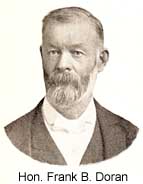 A farm in the town of Lisbon, near Ottawa, Ill., was the birthplace of Frank B. Doran, sixty years ago. Memories of a little log school house and rude benches that were hard to sit upon the livelong day still come to him, but they are half hidden by those of the successes and diplomas of later academic life. His school years ended with a finishing course in Wheaton college, completed in 1859. The next year, in 1860, he was one of the country pedagogues who flourished "before the war," and to whose elevated patriotism, liberally instilled into the minds of youthful charges, barefoot and overgrown, perhaps, but heroes at heart, our "land of the free" is much indebted. With the first call to arms in 1861 all books were thrown aside and together with many of his whilom pupils, he enlisted in the ranks of the 52d Illinois infantry. After a year's service as a non-commissioned officer he was honorably discharged in August 1862. In December of the same year, while on a visit to the Union forces in Mississippi he was captured by the rebels and successively lodged in twelve of the Southern prisons whose very name is fraught with horror and despair. Such experience as was Mr. Doran's during the two years and over of confinement in torture cells has been vouchsafed few living men, and at the end of it he came home a veritable shadow of himself, broken in health and spirits and thoroughly imbued with knowledge of the awful havoc wrought by war between men who should be brothers.
Mr. Doran's marriage occurred in 1865 and he subsequently became a stock raiser and farmer on a large scale. In 1881 he came to St. Paul, entering into the fuel trade, his present business. As a 6th Ward member of the city council in 1892 and 1893 he attracted much attention by his positive stand on some matters of municipal interest, chief among them being the granting away of valuable franchises to private corporations and the lessening of city expenses. In 1894 he received the republican nomination for mayor, but was defeated by Robert A. Smith. But a subsequent election in the spring of 1896 evinced his popularity with the masses and tended to strongly establish a republican rule. Mayor Doran's administration was characterized by his firm adherence to the principles which had won him aldermanic distinction.
In consideration of Chief Goss' comparative newness to police duty, his splendid marshaling of the forces during the G. A. R. encampment of 1896, which brought all of 100,000 visitors to the city, elicited unstinted praise and admiration on all sides. The chief had very effectively planned ahead and so was prepared to meet all emergencies. The sub-stations were drawn upon for one-half of their regular patrolmen, who were placed on beats in the Central district, and their positions filled by "specials," one hundred in all being engaged by the city. The detective department was also strongly reinforced. Consultations were had with the J. J. O'Connor Detective Agency, of which John Clark was at that time a member, and its cooperation with the city detective force was secured. In addition twelve expert sleuths from other cities were placed on guard.
The most criminal happening during the encampment was a hold-up in Smith Park. B. C. Tolliver was an old soldier, and a man generally supposed to be "pretty well fixed," hailing from Brookings, S. D. He was beaten into insensibility and robbed of $125 in cash by two desperadoes, Wm. Raleigh and Wm. Maloney. They were promptly captured and dealt with as their offense merited.
A letter from the mayor to the chief written immediately after the gala occasion is expressive of popular opinion at that time.
"The conduct of the St. Paul police force has been the topic of general commendation by our visitors and a source of greatest pride to our own people. To me as chief, ex-officio, of the city, the praises that have been bestowed upon your courtesy, your vigilance and your efficiency, by great numbers of people from home and abroad have been most gratifying. You have taken part in the greatest gathering of strangers ever witnessed in our Northwestern country and have aided largely in making it a remarkable success. Your accommodating department has won for you the enviable reputation of being in all respects the equal, if not the superior, of any department that has had to do with the order and comfort of our veterans during the past fifteen years, and, better than all, you have secured the admiration of our own people."
On the 6th of August, 1896, an arrest was made which seemed ordinary at the time, but which soon proved of national importance, inasmuch as it was the "beginning of the end" in one of the cleverest swindling schemes on record. Some time before that Marx & Co., on the corner of 7th and Sibley sts., had signed a contract for advertising in the "Buyers' Guide," purporting to be published in Philadelphia, the price to be 50c. And when a dapper looking man, seemingly possessed of all the intelligence fifty years of life can accumulate, appeared on the scene and demanded $6 Marx & Co. were naturally indignant. Their signature was there, they did not dispute that. But $6! No, they had never signed for such an amount. In the midst of it all Officer McEllistrom came in and arrested the man, who gave his name as Thomas Wills. Soon after his son, H. B. Wills and Frank E. Rose were put into custody, charged with complicity in a "fake" publishing scheme which thrived by means of carbon signatures and contracts filled in to suit the purse of a proposed victim. Various names were used in the transaction of "business," prominent among them being Rose Publishing Co., Managers' and Merchants' Guide, National Commercial Register and Buyers' Guide. It soon developed that a large number of cities had been "worked" in the same way, and public opinion was loud in its demands for justice. The accused men were admitted to bail and H. B. Wills escaped. Oct. 26 Detective Henry Gruber located an important member of the swindling gang named M. Roy Daniels, in Louisville, Ky. To save himself, this bright young man, who was little more than twenty-four years in age, but a veteran in experience, decided to turn states' evidence and was accordingly held as a witness. But M. Roy Daniels did not linger long enough to fulfill the hopes entertained at his capture. Given $1,000 and a ticket to parts unknown by confederates, he left town, much to the regret of all who had trusted to see justice vindicated.
Nov. 28 the indictment against Wills and Rose was quashed on the ground that the contracts made by them had never been legal. The affair was not dropped, however, for the so-called "mercantile directory" men were a menace not only to this community, but to the whole of the United States. Owing to the earnest efforts of Mr. Zollmann they were again apprehended, and on March 12, 1897, Frank E. Rose, alias T. R. Kane, was sentenced to serve a ten-year term in the state penitentiary. Thomas Wills was given his freedom.
A host of "fake" auction stores were looted by Mayor Doran during the fall of 1896, and all pawnshops placed under such police supervision as to materially aid the discovery of stolen goods.
The following winter, 1896-97, was marked by a financial depression, immediately due to the wrecking of the Bank of Minnesota and the Minnesota Savings Bank. By the failure of the former many handsome fortunes were seriously depleted, but when the news of the latter crash spread broadcast it wrought such havoc as St. Paul has seldom witnessed. The depositors had mainly been poor people, laboring men, servant girls, washerwomen, and in the list the names of widows and children appeared galore. There were many suicides among the poor that winter, many deaths resultant from hardship and privation, and as one account after another appeared in the daily papers people shook their heads and murmured, "Oh, those bankers."
On May 29, 1897, $13,600 was discovered missing from the teller's department of the National German-American Bank, and on June 2, "Charley" Zschau was arraigned for the theft. The money was afterwards recovered, part being deposited at the First National and part hidden in the little cooper shop of Zschau's father, a very worthy citizen, on whose gray head the news of his son's crime fell like a thunderbolt. It afterwards came to light that Zschau's speculations within the past six months had amounted to fully $6,000, all of which had gone to feed his mania for gambling in stocks. He was a remarkably intelligent young man of twenty-five, a law student at the state university, where he attended evening classes, and a member of the class which graduated in 1897. When his fellow students heard of his arrest they were very indignant and resolved to stand by him to a man. But he was adjudged guilty by his own confession and the grief of family and friends consequent on his downfall was pitiful to behold.
In April, 1897, the police pension law was repealed by an act of the legislature. Few changes took place in the department during the year, the office of license inspector being the only one created during Doran's administration. A new workhouse van, the one in present use, was bought for the sum of $300.
With the exception of innumerable burglaries of a petty nature there were few police occurrences in 1897. Gambling on a large and small scale afforded the city officials no little concern, but there was a notable decrease in state offenses.
Toward the end of the year in November, St. Paul was badly shaken up by what has been known ever since as the "Lambert Lake mystery." And from that time to this no one except the guilty party, has ever known whether to believe the whole affair an atrocious murder, or a most monstrous hoax. The body of a woman was found in the woods midway between the boundaries of St. Paul and White Bear village. The knoll on which it lay buried in the frosty leaves of early winter, had once been an island in the center of Lambert Lake, long since become a desolate hay-marsh. Immediately after the find all sorts of theories prevailed as to the identity of the woman who had been foully deprived of life and thrown there headless, soon to become a putrid skeleton. Most of the clothing had disappeared, and the left leg was missing. The skull was discovered near by, together with a silver side-comb and the remnants of an auburn hair switch. During the summer four people had camped near by and one of the women had frequent quarrels with a man who was not her husband. But inasmuch as none of these people were known by name nothing came of that clue. The remains were held at the morgue for some time, and finally buried, many officials connected with the case having arrived at the conclusion that a hoax had been perpetrated by some medical students. What tended most to strengthen this theory was the fact that none of the clothing found on the body was put on after the fashion of ordinarily fastidious, modern womankind. And with the burial of the bones the matter was dropped. Forever? Who can tell? Dead men, and even dead women, tell no tales.
In January, 1898, three men, Charles Setterstaedt, Charles Anderson and Andrew Swanson were arrested charged with burglary at wholesale, commensurate with the find of an extremely large quantity of miscellaneous merchandise in Setterstaedt's home on Whitall st. Five carriages of a decidedly new pattern, harness and horse blankets galore evidenced born horse thief propensities and a lot of stock fish clearly established the nationality of the men who purloined it. There were many other articles included in the capture. Detectives Sweeney and Daly were instrumental in making the capture and had the satisfaction of having the men indicted for grand larceny by the grand jury.
June 7, 1898, Col. Andrew R. Kiefer became mayor of St. Paul.
A sketch of Mayor Kiefer as the present head of the Police Department will be found at the close of the history.
With the spring election of 1898, Robert C. Hine became a judge of the municipal court, of which Judge Orr, elected in 1894, is senior judge. Placed in a position which, because of the many petty details handled daily, is naturally subject to much lay criticism. Judge Orr and Judge Hine have both been singularly fortunate in securing the confidence of the people at large.
Soon after entering office Mayor Kiefer and the corporation attorney were called upon to solve a knotty problem which had puzzled the police department for a long time. It came about in this way. George Fairbrother had a bicycle stolen from him and Detective Hallowell located it in Michmiski's pawnshop. When a demand was made for the wheel the pawnbroker refused to give it up unless a payment of the $6 he had advanced was made. Mayor Kiefer was indignant at this outcome and ordered Chief Goss to send an officer with Fairbrother for the purpose of seizing the wheel. Chief Goss demurred, raising the point that Fairbrother should secure a replevin, and contending that the police had no right to take the bicycle away from a store. But the mayor insisted and the wheel was forcibly taken. The chief thereupon demanded the opinion of Corporation Attorney Markham, who replied that though not strictly legal, the course pursued by the mayor was the only plausible one. Pawnbrokers knowing of the risk attached to advancing money on stolen property, would be more careful in future dealings with thieves. And he furthermore assured the chief that any action brought against an officer by a pawnbroker for forcible entry and seizure would be fully defended by his department.
It is a noticeable fact that since that time bicycle stealing and pawning has gradually decreased.
During the fall of 1898 four murders were committed in St. Paul. Besides this, a laboring man was killed by unknown assassins in July and an attempted murder, followed by suicide, took place in September. Of the man found dead in an orchard on Atlantic st., Post Siding, nothing was known at the time, and all the efforts of the local detective force have since failed to develop a clue. On Sept. 6 Swan P. Hellner, a tailor living on Margaret st., attempted to kill his wife. He was crazed with liquor and on her refusal to prepare a meal for him in the middle of the afternoon, deliberately fired three shots at her, all of which took effect. Then, perceiving his awful crime, he placed the barrel of the weapon in his own mouth and a moment later was dead, the bullet having entered his brain. Mrs. Hellner recovered.
Very early in the morning of the same day a murder was committed at exactly the opposite side of St. Paul, in the rear room of a little tea store at 269 W. 7th st. Arthur Middleton, the proprietor, was the victim. The shooting occurred a little after midnight, and owing to Middleton's being alone in the apartment which he occupied as a bed room, all evidence given by people interested in his fate was bound to be purely circumstantial. He had, according to his dying statement, been awakened by a noise in the storeroom, which led to an open back yard. Turning on an electric light at the head of his bed he saw two men standing in the door-way of his bedroom. Immediately afterward three shots rent the air, and with the last Middleton felt himself mortally wounded. Crawling out of bed and through the front door onto the sidewalk, he managed to attract attention by his cries.
"Murder! Police! Murder! Police!" These were the gruesome calls heard by residents in the vicinity and by a midnight street cleaner, who drove up, finding a man clad only in an undershirt on his hands and knees on the sidewalk in front of his place of business. A deep wound in the breast clearly showed his dying condition. Officers Fillingim and McCormick had also heard the shots and lost no time in hurrying to the spot. The wounded man was soon after taken to the city hospital, where he breathed his last at about 3:30 a. m.
His story of two burglars was not generally believed. It was thought by many that he told it in order to shield the real criminal. And because women are supposed to be implicated in every case possessing human interest, so too, it was on the woman in this case that suspicion fell, hot and heavy. She was a Mrs. Y——, who kept a boarding house on a side street, and her back yard was immediately adjacent to Middleton's. On the night of the murder he had gone with her to see her sister off at the depot and had been seen in her company as late as 12 o'clock. The fact that she was the last person known to have spoken to him and a washerwoman's report of a quarrel alleged to have taken place between a man and a woman in the Y—— yard shortly before midnight, led to her arrest, on the night of Sept. 7. She was confined at the Central Station and in the county jail for nearly a week, then her innocence being fully established, was set free by Judge Orr.
Not long after, a silver watch taken from the pocket of Middleton's trousers on the night of the murder, was brought to Sheriff Wagener, by a man named Nic Kauth, who claimed to have been given it by a brother of the murderer, whom he designated as "Slob" Edmunds, but owing to insufficient evidence the men are at large today, and the Middleton murder, like many others, has become a well-nigh forgotten mystery of the past.
A little after 12 m., on the night of October 18, 1898, Eva Woodworth, whose real name was Ruth Parrish, a "woman of the town," was shot and instantly killed by John Steenerson, a young Swede, in her room at 137 E. 9th st. He had met the woman in a down-town saloon and after a round of drinks had accompanied her to her home, where the drinking of beer was resumed. Finally the woman asked Steenerson for the wherewithal to get more liquor and he gave her a five-dollar bill, on condition that only twenty-five cents should be expended. On receiving the money "Mrs." Woodworth refused to get the proposed "can" and also declined absolutely to return the money. With a pistol levelled at her breast he threatened to kill her if she did not give it up, but she persisted in her refusal. Then he took deliberate aim and shot her through the heart. He was an ignorant foreigner, hardly able to talk English. As soon as he saw what he had done he rushed out into the hall and through the basement of the house, breaking a cellar window in his flight. Officer Bernard F. Ryan soon had him landed in the Central Station. On Dec. 1, he was given an indeterminate reformatory sentence, which may mean detention in St. Cloud for only a year if the prisoner behaves himself.
"I am convinced that the prisoner is not a criminal by training or profession," said Judge Brill, before pronouncing sentence. "I have overlooked neither the gravity of the offense nor the extenuating circumstances. I shall expect this to be a lesson to him to keep out of the way of temptation hereafter."
A bright young woman named Kitty Marrinan was the next victim of a fatal bullet. It was fired by her brother-in-law, Daniel Coughlin, an ex-locomotive engineer, and was immediately followed by his own suicide. The tragedy, which occurred at 537 Broadway, was caused by a quarrel over property. Miss Marrinan had fallen heir to a cosy little homestead, built partly with her own savings, to the exclusion of her sister, Mrs. Coughlin. She was willing to provide for the latter, but wished to have Coughlin, who was going blind, sent to a state institution. This prospect infuriated Coughlin, and when she came to his house for lunch at noon on Oct. 26, a dispute was entered into and two dead bodies found as a result.
A pool table tete-a-tete of a very unpleasant character led to the next murder, on Nov. 15. August Hesse, scarce twenty-one, was playing pool in a Jackson st. saloon, when John Shanley, badly intoxicated, brushed against him, hitting him a hard blow on the knee. Hesse turned round and said: "Friend, you want to look where you are walking." Whereupon Shanley assailed Hesse in language well calculated to incite the latter's wrath. Pausing in the doorway he called Hesse a string of vile names, and as Hesse approached him he doubled up his fist as if to strike. With a single blow Hesse levelled him to the ground. There were fully sixty men in the place, and the dull thud resultant from the knocking of Shanley's head against the floor, followed by streams of blood oozing out of his ears, caused intense excitement. In the meantime Hesse was warned to "get out." Shanley died that same evening. Had Hesse not confided the details to a sweetheart over in Minneapolis and she in turn transmitted the news to a friend, the identity of Hesse would probably never have been established. As it was, be was never held for murder, the grand jury not finding him guilty of more than assault under strong provocation.
During the ensuing winter a hold-up craze seemed prevalent all over the city, and burglaries were frequent. Owing, however, to exaggerated accounts of trivial happenings being given in the daily papers, the real nature of many police doings were never ascertained by the public at large.
A sensational raid of a shop-lifting "plant" was made by the police on Dec. 23, operations having continued for some time in rooms almost opposite the Central Station, at 98 W. 3d st. A colored woman had been arrested in Minneapolis for the theft of a lot of pocket handkerchiefs, and her request that Carl H. Park be notified of her detention led to a find by which all of a half dozen retail stores were considerably enriched. Park came of a good family, and the colored woman, who was his common law wife, had once been a cook for his mother. Her sister. May Dayton, assisted the pair in their rounds. The women were given workhouse sentences, but Park, as leader and instigator, received three years in Stillwater.
The official report of Chief Goss for the year ending Dec. 31, 1898, shows the police department of St. Paul to consist of the following: One chief, 1 secretary to the chief, 1 chief of detectives, 4 captains, 7 lieutenants (including one mounted), 10 sergeants (including 1 mounted), four detectives, 2 special detectives, 1 superintendent of police telegraph, 1 license inspector, 1 driver workhouse van, 1 janitor (Central Station), 1 matron, 148 patrolmen. The latter number has, however, not been stationary.
Of the 148 patrolmen only 121 were available for patrol duty, including 8 mounted and 12 bicycle police. Twenty-seven were detailed as follows: One dog license inspector, 3 bailiffs municipal court, 1 desk sergeant, 1 detailed in mayor's office, 1 at Union depot, 2 conductors patrol wagon, 6 drivers, 7 jailors, 1 conductor workhouse van.
Chief Goss was urgent in his recommendation that a new Central Station, with modern improvements and located near the city hall and courthouse be provided. The all too frequent escapes from cells at the present one should be conclusive evidence that a new building is badly needed. There is a constant demand for more room and it seems especially necessary that quarters be provided for the police matron, Mrs. Cummings, who is now available only if at home when called. She occupies a flat of rooms immediately adjacent to headquarters together with her four children, and receives a salary of $50 a month.
The present telegraph alarm system, in charge of Supt. Joseph King, is also declared badly in need of re-modification. This department occupies the east side of the second floor of the Central Station, and its value as an adjunct to police service cannot be overestimated.
The following table, compiled for 1898, is interesting in that it presents an apt illustration of the voluminous duties of the Police Department:
| Accidents reported | 278 |
| Attempted suicides | 12 |
| Defective walks | 409 |
| Dead bodies found | 10 |
| Death by accident | 9 |
| Doors found open | 2,515 |
| Insane persons cared for | 40 |
| Cattle and horses reported stolen | 7 |
| Cattle and horses reported lost | 229 |
| Gas lamps not lit | 105 |
| Oil lamps not lit | 3,172 |
| Electric lamps not lit | 61 |
| Lost children taken to parents | 177 |
| Mad and crippled animals killed | 344 |
| Meals served prisoners | 4,073 |
| Miles traveled by patrol wagon | 8,634 |
| Nuisances reported | 4,073 |
| Runaway horses stopped | 122 |
| Sick and injured persons cared for | 224 |
| Stray teams cared for | 45 |
| Cattle and horses cared for | 134 |
| Stolen vehicles recovered | 55 |
| Suicides reported | 8 |
| Street lamps broken | 35 |
| Sudden deaths | 8 |
| Stray horses taken up | 147 |
| Vehicles reported stolen | 3 |
| Arrests made by wagon | 2,643 |
| Box calls for wagon | 2,018 |
| Special calls for wagon | 1,236 |
| Fire calls responded to | 423 |
| Extra duty performed | 796 days |
The year 1899 has been crowded with petty police details and the municipal judges have been busier than ever before. Only one offense of a particularly criminal nature is on the record. That is the assault and robbery of Michael Treacy on Saturday afternoon, April 1. In bringing the perpetrators to light the detective department of St. Paul has reason to congratulate itself on as fine a piece of work as northwestern police annals have ever known.
It had been a custom for eighteen years past with the firm of Brown, Treacy & Co., on E. 3d st., to pay off the employes in the binding and composing departments every Saturday afternoon, and Mr. Michael Treacy invariably carried the bag containing the weekly earnings separately wrapped in little envelopes, upstairs at about 5:30 p. m. On the day of the robbery he was a little later than usual and was carefully making his way up the dark stairway leading from the office, when a blow, wielded by an unknown hand, felled him to the floor of the first landing. He was found badly bruised and groaning, a few minutes afterward, but the bag with its contents, amounting to $493, was gone.
The police and detective department was puzzled, and it had a good right to be. Not a clue could be found, not even a suspicion on the part of Mr. Treacy, as to who his assailant might be. It was generally supposed that two men were implicated, although no one on the street had noticed any one at all coming down the stairway before 6 o'clock. So the detectives hunted for two and the story of their search is very interesting. Almost immediately on learning of the robbery Detectives Werrick and Wells were detailed on the case and were taking notes within half an hour after it happened. Not much could be ascertained in the building, for a thorough examination of the employes failed to discover that any one of them had seen aught of a suspicious character prowling about. The first clue was given by a merchant next door, who stated that he had seen someone on the stairway at 5:50 p. m. Another man substantiated his words, but neither could give a satisfactory description. A list of employes, past and present, was secured, and when the name of Charles Raaen appeared as that of a boy who was discharged because of his record it was at once fastened upon as worth looking up. The prevalent idea of the detectives was from the first that the miscreant or miscreants, must at one time have been very familiar with the methods of the firm, and the inner winding of the stairway. In the meantime a young man named Edward Beaver, a student at the Globe Business College, was reported missing from his boarding place, and together with the fact that he and Raaen were known to be good friends, this item served the detectives in good stead. Raaen was also missing from his room immediately next to the Brown-Treaty place of business. After some little inquiry it was found that the two had visited a low resort in Minneapolis on the night after the attack — they were boys of seventeen and twenty — and had stated on leaving that they were going to Beaver's home in Lake Park, Minn. Beaver was apprehended there, and confessed in full, stating that Raaen, the younger of the two, had both assaulted and robbed Mr. Treaty, but that he had helped to spend the money taken. It was not hard after this to find Charles Raaen at his home in Neenah, Wis., indulging in his long-cherished ambition of "acting the swell," and treating all the Neenah girls to soda water and pop-corn galore. He, too, needed little persuasion to make him confess, and his testimony alone would have served to convict him as an utter degenerate. To be a second Jesse James, known for his daring and nerve, seemed to him the height of fame and he sustained his bravado and repeated his reiterations that he "certainly would do it again," until the moment when Judge Kelly pronounced sentence. Then be broke down and cried just as many a better boy might on receiving trivial punishment. Eight years in the state penitentiary certainly did not afford an alluring prospect, much less the suggestion that he would become the boy hero of local criminal annals. Beaver received an indefinite term in the St. Cloud reformatory.
Another example of youthful depravity was vouchsafed by George Sametz, the boy who disguised himself as a messenger in order to "sneak" into residences under pretext of finding street numbers. On being caught for a most daring theft on E. 10th st. he was locked up in the Central Station. Here Jailer Harris allowed him the liberty of the corridor because of his youth. Prying open a window, he crawled along a narrow ledge of the stone front, and by scaling a fence, soon managed to reach the street, and effectually make his escape. After eluding justice six weeks word came from St. Joseph, Mo., stating that the juvenile criminal was safe behind bars and asking what disposition to make of him. So the "messenger sneak" was brought back. There were many sneak thieves who stole more than he, but for his years he is accounted the shrewdest criminal on record. In January a rich haul of jewels was made from the residence of M. J. Donnelly, on Pleasant av., $700 worth being taken. A great many other burglaries were committed at that time and efforts were repeatedly made to trace the stolen property, but largely without avail, until a man named Gorman was cleverly trapped by a woman and held for trial. When arrested his physical condition precluded all vigorous enforcement of the law.
An "office thief" named Dahlgren was convicted of pursuing his specialty on a large scale in May and on July 12 he was given ten years in Stillwater, a salutory lesson to those inclined to follow in his footsteps.
Then there was the "St. Anthony Hill Terror," who is alleged to have had a mania for waylaying young women, most of them domestics who were abroad in the early hours of the evening.
The Franklin C. Bishop case created quite a little excitement while on trial. Incidentally the "police spy" system and the system of fining owners of "rooming houses" were dwelt on at length. They were well defended by City Prosecutor Arnold, who argued that police officers acting as spies were sent out under orders and that the present method of exacting fines from disreputable people is not for the purpose of revenue, but because no other check to the spread or the social evil has ever been found.
Police officers, too, have had their grievances during the past spring and summer. It is said that more patrolmen have been beaten and pounded up within a year's time than all the records of eighteen years back can show. Officers Manteuffel, Hughes, Houska, Hoefer and Urbanski were all assaulted at various times. Then, early in June four men attacked Officer Frazer with an iron whip handle, beating him over the head until he was stunned. At this juncture they ran over him with a heavy sand wagon, and only Mr. Frazer's great strength and vitality protected him from an untimely death.
Sergt. Andrew J. Rose, of the Rondo st. station, was the last man to suffer. Shortly after midnight on June 24, he encountered a crowd of "toughs" loitering about the corner of Rice and Lafond sts., and ordered them to disperse. As he turned to go one of the fellows struck him from behind and knocked him senseless. All the others followed suit, jumping upon the unconscious officer and pummeling him unmercifully. On hearing sounds of a fight patrolman Lindgren hurried to the scene. He was roughly handled at first, but managed to overcome his assailants with a club. Then they took to their heels, and four of them were subsequently arrested. For some time Sergt. Rose lay in his home on Martin st. in a precarious condition and has only lately been able to report for full duty.
And this is St. Paul after forty-five years of civic existence, a saint in name and often in deed, but too human in all its dealings with both an inner and outer world of ambition and toil, and strife, and crime, to ever aspire to other than a terrestial crown. Character, whether it be of a man or a municipality, is only to be acquired through experience. Rounded by adversity and chastened by the hand of Time it cannot other than gain beauty with the passing years. The growth of St. Paul has been of a dual nature. When, at times, lawlessness and disorder have prevailed to an alarming extent, innate forces — the reserve power of religion and society — have served to maintain a stoic semblance of calm and quiet. And to the pioneers of St. Paul, the property owners, and the office-holders, and the laborers who have helped to build the city, credit is chiefly due for its present magnificence of size, and strength, and feature. Their all enduring faith in progress, and their sometimes rough, but usually true culture wrought wonders in a wilderness, and today it is only a pity that so few are alive to reap the fruits of their own sowing. It is a pity, too, that they cannot see the work of their sons, visible in a city government which has few equals in its various departments, and notably not a peer throughout the United States in the one branch on which all law and order depend — the branch called — the St. Paul Police Department.
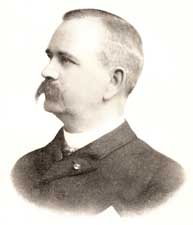 MAYOR ANDREW R. KIEFER
An intelligent man who means "no" when he says "no," must be a power politically; he can be trusted by an entire party. So too, the man who says "yes" and means it, is sure of social success; he is at least no hypocrite. Add to these qualities commanding dignity of carriage, extremely handsome presence, eloquent speech, winning grace of manner which is magnetic, and you have the chief characteristics of the mayor of St. Paul, Andrew R. Kiefer. And you have also the reason why he is so popular, especially with "the ladies," who can perhaps appreciate true politeness all the more because of the common lack of it. Mr. Kiefer was born at Marienborn, near Mainz, on the Rhine, Germany, and attended school in both places. In 1849 he came to America, and six years later to St. Paul. At the beginning of the civil war in 1861 he answered Lincoln's first call for volunteers, by organizing, together with Lieut. Mainzer, the first German company in the state, known as "Co. G., 2d Regiment Minnesota Volunteer Infantry." As its captain he took part in a number of battles, notably the fight at Mill Spring, the first battle which resulted in victory for the Union troops. In 1863 he was appointed provost marshal of Triune, Tenn., and subsequently was commissioned colonel of the 32d regiment, Minnesota State militia. In 1864 he was elected to the legislature of Minnesota, and in 1878 was clerk of the district court of Ramsey county. On retiring to private life he went into the real estate business, being connected for a time with Edward J. Schurmeier, under the firm name of Kiefer & Schurmeier. He also held offices in a number of insurance companies and was one of the originators of the Hail and Storm Insurance company.
In 1892 he was elected to the 53d U. S. congress by the Republican party, and in 1894 received a second term at its hands. On June 1, 1898, he became mayor of St. Paul, and by his vigorous attack of old abuses as well as by an energetic substitution of new reforms wherever needed, has ably demonstrated his ability to give the city a clean, well-balanced administration.
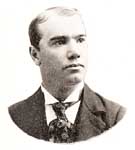 FREDERICK O. HAMMER
Whenever the name of Frederick O. Hammer, the mayor's secretary, is mentioned in his favorite haunts, be it as a Lincoln club-man, or as a brother at wholesale to innumerable knights and sir knights, it is always coupled with the assurance that he is "a jolly good fellow, don't you know." And as such he has hosts of friends and no open enemies. His father, Jacob Hammer, was a pioneer resident of St. Paul, settling there in 1856. Born in the Saintly City Aug. 11, 1865, young Hammer attended public and private schools until he was sixteen, when he entered the office of Col. A. R. Kiefer, then clerk of the district court. He has been associated with the mayor ever since, invariably occupying the position of secretary in enterprises in which Mr. Kiefer was president, notably a hail storm insurance company and several building and loan associations. In 1890 Mr. Hammer was married to Miss Lavanche Barnum, a Nebraska lady. He stepped into his present office June 7, 1898, and it can safely be said that no secretary has ever given better satisfaction to the countless questioners who besiege a mayor's office than he, both as a human encyclopedia and as the most suave and obliging of gentlemen. He is a prominent Mason, a K. P., a Junior Pioneer and a member of the Lincoln Republican Club.
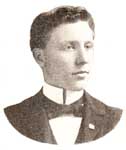 REGINALD HALL AMES
In Minnesota a family is accounted old because it settled there in territorial days, whereas in New England only those in whom the blood of Pilgrim or Puritan flows are accorded ready preference in point of age. The family from which Reginald Hall Ames claims proud descent is justly entitled to both distinctions, for his grandfather came to Minnesota in 1850, and another far-off English ancestor touched Plymouth Rock as early as 1638. Reginald was born Feb. 16, 1877, at Grey Cloud Island. Minn., where his father, Oliver Ames, owned the Grey Cloud Stock Farm. His birth-place had once been an Indian trading post, and the circumstance tended largely to envelop the early childhood of Mr. Ames in a semi-savage, semi-romantic atmosphere, wholly absent from the lives of most country boys. When six years old his father died and the family went to live in St. Paul where Reginald attended school, graduating from the Central High School in 1897. The following year he entered the office of A. R. Kiefer as stenographer, and when Col. Kiefer became mayor of St. Paul, went with him in an official capacity. On July 5, 1898, Mr. Ames was appointed a member of the Police Department and detailed for duty in the mayor's office. He is the youngest member of the force and lives at 1111 Reaney st. He is a member of the K. O. T. M., and the Order of Columbian Knights.
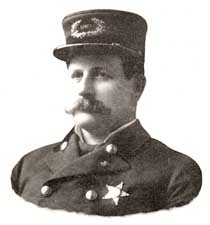 MICHAEL N. GOSS, CHIEF OF POLICE
To a large inland city through which a restless, lawless, ever-ebbing tide of humanity must constantly have its flow, contaminating here, and wrecking there, in a desperate surge toward an infinite depth of crime, the selection of a chief of police is of inestimable importance. When Mayor Doran, shortly after his inauguration in the spring of 1896, fixed his choice on Michael N. Goss, like himself a citizen of the West Side, his action was universally commended. It was thought then that Mr. Goss, as a man of irreproachable honor, determined character, and undisputed intelligence, would make a splendid official record, and so far all predictions have been not only realized but signally exceeded by an unusually successful police administration.
Chief Goss is a magnificent specimen of manhood, an ideal athlete in point of form and stature, and of a singularly agreeable presence, well calculated to inspire all who meet him with respectful admiration of his many admirable qualities and supreme confidence in his ability to protect St. Paul.
He was born in Lancaster county, Pa., Jan. 9, 1859, and at two months of age was an orphan. That his early education should have been somewhat curtailed as a consequence is quite natural. Nevertheless, when a boy of thirteen he had succeeded by dint of iron perseverance and native energy in accumulating enough knowledge of the world in general, to enable him to make his own living; going to school and working for his board sometimes, and at others doing the work of a man in summer so that he might become a pupil in winter. Five years passed in this manner, and at eighteen turning westward as far as St. Paul, young Goss became a brakeman for the St. P., M. & M. Ry., now the Great Northern. Promotion to the position of conductor on this road, and later, on the Northern Pacific rapidly followed. Early in the 80's Mr. Goss was married to Miss Jessie Snow at Wheatland, N. D. Miss Snow was born and brought up in St. Paul and came of a prominent pioneer family, her parents having located there in 1854. Two bright boys, Arthur and Milton, aged thirteen and fourteen, now gladden their home. Subsequent to his marriage Mr. Goss went into the drug business in North Dakota. Returning to St. Paul in 1888 he assumed the management of the Blackwood Bottling Company, and five years later was appointed a deputy sheriff of Ramsey county by Sheriff Chapel. Then, on June 1, 1896, he was given the title of chief of police, carrying it so well, even during the first few months of his incumbency, that after the G. A. R. encampment of September, 1896, St. Paul became known far and wide as one of the most orderly, well-governed cities extant. Not a serious robbery or act of violence had occurred during the entire thirtieth encampment, and only to the excellent discipline and untiring vigilance of Chief Goss, ably abetted by the united endeavor of rank and file, can this remarkable circumstance be ascribed.
That the sympathies of the chief are largely fraternal is demonstrated by the fact that he is a Mason of the thirty-second degree, an Elk and a Knight of Pythias, as well as being a charter member of the St. Paul Commercial Club and an officer in Division No. 40, Order of Railway Conductors.
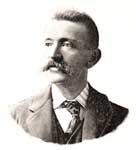 JOSEPH N. MOUNTS
Was born at Morrow, Warren Co., Ohio, Oct. 25, 1859. When five years old his parents moved to Loveland, Ohio, where his father was connected with the Little Miami Division of the Pan Handle Railroad. In the year 1871, his parents both died, and he then went to live with an uncle who had a farm near Hopkinsville, Ohio, and where Mr. Mounts lived until he was seventeen years of age, when he thought he was old enough to "hustle" for himself, and consequently hired out to a farmer in the neighborhood for ten dollars per month. In the spring of 1880 he got the "Western fever" and started for St. Paul, arriving here April 15 of that year with only ten dollars in cash and one suit of clothes. The following morning bright and early he started out to find a position of some kind and before noon had secured employment in a fruit store on 3d st., between Robert and Jackson, where he remained but a short time on account of not liking the business. The following day after resigning he was offered a position with Reynolds & Cobb, retail grocers, doing business at 165 W. 3d st (that street being the principal business street in the city at that time) which he accepted, and remained with this firm for three years, when he was offered a better position and larger salary with George K. Kent, who was conducting a grocery at the corner of Wabasha and College av. He was in Mr. Kent's employ for four years, and becoming somewhat tired of the grocery business he thought he would like a change and applied for a position as Pullman car conductor, and secured the position the following week. He remained with the Pullman Co. for some time, running between here and the coast and also to Chicago. Owing to sickness in his family he was compelled to resign and concluded to go into business for himself, and consequently opened up a grocery store at the corner of Dale st. and Ashland av., which he conducted until the spring of 1892, when he sold out and later on secured a position as city salesman for McCormack, Behnke & Co., wholesale teas, coffees and spices. He remained with this firm for one year when he went on the road for Menk Bros., wholesale grocers. In the spring of 1896 he was given a position in the sheriff's office under Sheriff Chapel, and upon the election of F. B. Doran as mayor, he was appointed secretary of the police department, which position he still holds.
Joe (as he is familiarly known) has a host of friends and is a great favorite with all the members of the police department. He is a prominent member of the Order of Modern Woodmen, holding one of the highest offices within the gift of the lodge to which he belongs, they having a membership of over seven hundred. He is also a member of Lincoln Lodge, K. of P., Woodmen of the World, Modern Samaritans, and Royal Neighbors.
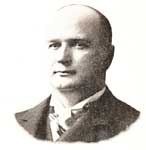 PHILIP W. SCHWEITZER, CHIEF OF DETECTIVES
For many years past Philip Wendell Schweitzer, chief of St. Paul detectives, has borne the reputation of being the handsomest man on the force. But so genial and hearty is he in disposition, so social and obliging by nature, that he would win friends readily were he without the slightest pretension to good looks. When necessary the chief can be severely dignified and even stern, with a firmness which is at direct variance with his apparent easy courtesy; qualities which go to show how really well balanced he is at all times. He was born in St. Paul in March, 1858; received his education in a German parochial school and later in the public schools, and on leaving there learned the butcher trade. This last move was resorted to as a measure of health on the principle that a butcher is never a consumptive. At any rate, health and success in business became assured factors of his career and he was for many years a prosperous local meat dealer. On May 12, 1883, Mayor Edmund Rice appointed him a patrolman, and four years later, May 1, 1887, he became a sergeant, by favor of Mayor Smith. During Mayor Smith's second administration, May 31, 1890, he was again promoted, this time to the position of lieutenant. It is well known that his captain's commission, conferred by Mayor Wright, was entirely unsought. But the fact that it was given him December 3, 1892, when Mr. Schweitzer was a young man of only thirty-four years of age goes far toward exemplifying the esteem in which he was held by his superiors in office. When the movement to make him chief of detectives was agitated he protested, pleading inexperience. But Mayor Doran knew his man, and seldom has a choice proven more happy and satisfactory to all concerned than that made June 2, 1896, when he assumed his present responsible position. Chief Schweitzer was married to a St. Paul lady, belonging to a prominent pioneer family early in the '80's, and there is now a brown-eyed Philip. Jr., who bids fair to become quite as popular as his father.
The chief is very fond of his home and most of his spare time is devoted to his particular hobby, that of raising fine poultry. As a chicken fancier of the most pronounced type he is known to possess one of the finest collections of fowls in the Northwest. He resides at No. 972 Charles st.
DONALD C. CAMPBELL
One of the detectives of the present force, was born at Arbroath, Scotland, March 17, 1857. He was appointed to the force by Mayor Doran June 6, 1896. He formerly conducted a private detective agency.
MICHAEL H. DALY
Was born in Manchester, N. H., in 1852, and was appointed to the force June 7, 1894, and is now doing duty as a detective at the Central Station.
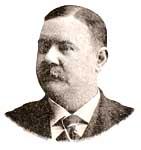 JAMES C. MURNANE
The work of a city detective is seldom appreciated as it should be by those whom it chiefly concerns for the very good reason that the more effective it is the less obtrusive it must be. Nevertheless, as in other professions requiring skill and daring, there is a satisfaction in duty well performed, which to a detective means more than the laudation of a public. One of the ablest of St. Paul sleuths is James C. Murnane, whose father, Patrick Murnane, was one of Minnesota's earliest settlers, coming here in 1848. The younger Murnane was born in St. Paul, Feb. 4, 1859, and received his education at the Jefferson school. On leaving there he joined a U. S. government survey party and during the next year became well acquainted with the winding of the Missouri between Lincoln and Benton, and the wild scenery of the Yellowstone, at its loveliest, near the mouth of the Big Horn. Subsequently he worked for a wholesale house three years and in 1881 went to Duluth, where he spent two years in the employ of the Duluth & Western Railway. He was engaged in real estate in the Minnesota pineries for a year, was four years a wholesale liquor merchant in Superior, and two years in the employ of the Gooding Detective Agency. His appointment occurred June 3, 1896. He lives at No. 677 Wabasha st.
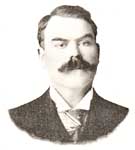 JAMES WERRICK
The name of James Werrick is well known to every reader of a St. Paul daily, for there is seldom an important local crime committed in which he does not have a hand at the sifting. He is thirty-nine years old and was born in Carver, Minn., coming to St. Paul with his parents a year later. When he had finished the common schools he worked successively for a lithographing establishment, a plumbing shop, a candy factory and at the learning of the carpenter and machinists' trades. Perhaps it was because of this early inclination to know all the ins and outs of artisanship that he is now enabled to draw so unremittingly upon the store of general knowledge which is a detective's stock in trade. At any rate he did not stop there, but worked two years as a locomotive fireman and two and a half years as a harness maker previous to his appointment to the police force, May 18, 1882. In 1885 he resigned and went to St. Louis, Mo., engaging in business there. In June, 1886, he was reappointed a patrolman and on the opening of the Margaret station, walked a beat in that district one year, after which, he became a detailed detective. In 1893 Mayor Wright appointed him a regular detective and during Mayor Smith's administration he worked for a private agency. Then when Doran came into power he was reappointed a detailed detective; later, in 1897, receiving his present position. He has figured extensively in a number of celebrated cases, notably the bringing to justice of Wonigkeit and Irmisch, the arresting of "Spec Elms" or White, now a lifer at Stillwater, and the tracking of the youthful would-be murderer in the recent Brown-Treaty robbery.
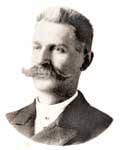 CAPT. PARKER L. GETCHELL
Viewed in the light of a branch institution the Ducas St. Sub-station has always been regarded as a model of its kind, and to Capt. Parker L. Getchell, as its head, most of the credit attached to its excellent discipline must naturally be awarded. He was born in Wyoming Co., N. Y., in 1853, and is therefore forty-six years old. The greater part of his life has been spent in St. Paul and previous to his entering the police department, eighteen years ago, he followed railroading in various capacities. June 23, 1881, he was appointed a patrolman and six years afterward became a sergeant. In April, 1893, he was promoted to the position of lieutenant, but the following year was reduced to sergeant. With Mayor Doran's inauguration, June 2, 1896, he was given charge of the Ducas St. Sub-station and the rank of captain.
During his first year of service, in 1881, Capt. Getchell made an important arrest of house-breakers, wounding one of the burglars and capturing the chief, Lavalle. He has done invaluable work both for the city and for humanity during the Mississippi floods which periodically immerse the flats of West St. Paul.
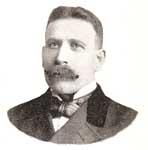 CAPT. ADELBERT M. LOWELL
Many, many years ago, when all the civilization of the new world lay centred in a few log huts, scattered along the bleak North Atlantic shore and protected only from storm and gale and savage onslaught by dense, primeval forests, Percival Lowell (or Lowle), a zealous Pilgrim, for love of life and liberty, put aside all love of home, and friends, and comfort, and became the first to leave Bristol, Eng., for a comparatively unknown land. That was in 1639, and his harbor of refuge was Newbury, Mass. Now. in 1899, a record shows that since then eight thousand Lowells have lived to claim direct descent from him. Among them is Capt. Adelbert M. Lowell, of the Rondo St. Sub-station. One need hardly be told that the genial captain is a Maineite, for accent and bearing both betray him. He was born in Aetna, in 1847, but as a child was taken to Bangor, where he attended both common and select schools. He did not finish his education, however, for with the Civil War sweeping death and devastation all over the country, fires of youthful patriotism burned so very fiercely as to quite outbalance the usual thirst for knowledge. Instead he enlisted as a landsman in Admiral Dahlgren's squadron and served a little over two years. The fleet was called the South Atlantic Blockading Squadron and its object was to guard the coast states on the other side of the Mason and Dixon line. After serving eighteen months young Lowell was offered a commission, but he refused it and in 1865 went back to Bangor. In 1869 he came to St. Paul, and engaged as a shipping clerk for S. L. Sheldon & Co., then a wholesale machinery firm located on the lower levee. On the last day of August, 1872, he left their employ and on the 18th of September was appointed a patrolman.
Dr. Stewart was mayor of St. Paul then and there was a police force of only two dozen men, including officers in charge. In March, 1885, he became Sergt. Lowell and two years later, on May 1, 1887, Mayor Smith gave him a captain's commission and full charge of the Rondo St. Sub-station, then just opened.
The Rondo district embraces all of St. Anthony Hill, on which the best residences of St. Paul are located. It naturally follows that Capt. Lowell has to deal largely with expert burglars of all types, and in doing this it may safely be said he has never let public opinion interfere with duty, in any way. A born gentleman, he is kindly by nature, and no amount of habitual intercourse with the seamy side of life has been able to disturb the unvarying courtesy which is one of his chief attributes.
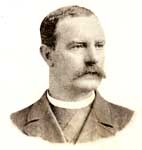 CAPT. PHILIP POTTGIESER
There is not a more popular gentleman in St. Paul than Philip Pottgieser, captain of the Margaret St. Sub-station. A Prussian by birth, he is decidedly American in ideas and except for the impression of "gemuethlichkeit" conveyed not only by his every action but by every nook and corner of his scrupulously well-kept little office, one would never suspect him of being born across the water, in sedately narrow Germany. He came to St. Paul when a child of five and is now forty-seven years old. After completing the routine of public school life he became a boiler-maker and was employed in this capacity for many years. Five years previous to his appointment he worked for the Pullman Car Co. He joined the police force in May, 1882, and walked a beat until April, 1889, when he received his promotion as sergeant of the Central Station. Shortly after this he had a thrilling experience with a gang of burglars on Mississippi st., narrowly escaping with his life. He became a lieutenant in 1893 and on June 4, 1896, assumed his present post as captain. Though he usually accompanies his officers in making important arrests, Capt. Pottgieser, having won his own spurs, seldom claims present glory, preferring with commendable generosity to put a good man in the way of promotion every time. So but little is known of the way Murderer Moshek's revolver came to be discovered in the ash receiver of a kitchen stove, and of innumerable other instances, in which equally acute detective skill was demonstrated on the part of the captain. One of the most curious arrests on record occurred early in the '80s. Capt. Pottgieser, who was then Officer Pottgieser, and out on night duty, was approached by a man who told him that a stranger, then lunching in a centrally located cafe wished to hire a hack for the conveyance of himself and a lot of furs to Minneapolis. It was long past midnight and the officer's suspicions were immediately aroused. After considerable ferreting he discovered the man who wanted a ride. And not only did he grant his wish but stood treat for the trip, stipulating only that it be to the Central Station instead of to Minneapolis. Arrived there he found that a robbery of $1,400 worth of furs had been committed that night. Another peculiar arrest made during the captain's patrol service, was of a man who incurred doubt because he asked what he should have known, the location of corner Wabasha and 7th sts., and because he wore one new shoe. A small lot of shoes had been stolen that night, and following the man through a maze of alleys, Officer Pottgieser had the satisfaction of arresting the thief in the very act of dislodging his steal from the midst of a heap of refuse. He resides at No. 537 Park av.
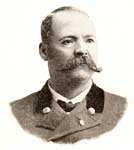 CAPT. CHARLES T. ROULEAU
Of all the children born in "Lower Town" twenty-five and thirty years ago, there are few who do not remember a stalwart, handsome young policeman, who used to chase away tramps, and stop runaway horses, and shake his finger at the little girls who fired toy pistols on the 3rd day of July. His face was so kind, however, and his smile so reassuring that he seldom frightened them a great deal. That was Officer Chas. T. Rouleau early in the seventies, now Capt. Rouleau is a robust, well-preserved man of fifty-three, the little girls are women, and the "French Hill" which used oft-times to conceal tramps from view, has long since been but a memory of the past. Capt. Rouleau's father, Charles T. Rouleau, Sr., was one of the earliest settlers of the Northwest, coming here from Canada in 1829, and engaging in the service of the American Fur Co. Later on he was one of the pioneer mounted mail carriers and in '45, when he removed his family to St. Paul, a hamlet of twenty families, he took rank as the first cooper there. A carpenter by trade, he hewed the logs and took a hand in the building of the first hotel, "The St. Paul House." Rouleau, Jr., was born shortly after the family came to St. Paul, and was one of fourteen children, eight of whom are still living. His early education was not extensive, because at that time there was no school house in St. Paul, and schoolma'ams energetic enough to open a session commonly closed it soon after to follow the example of Miss Rumsey, the first schoolmistress, "and get married." When eighteen young Rouleau enlisted in Co. A, Hatch's Battalion, Minn. Volunteers, and was on detached service, which consisted of taking prisoners South until the close of the Civil War in 1865.
John S. Prince then controlled extensive lumbering interests along the Mississippi, and, during the next six years Capt. Rouleau worked for him. April 10, 1872, he was appointed to the police force, which then numbered seventeen men, not counting Chief McIlrath. After ten years he received a sergeant's commission from Mayor O'Brien. A lieutenancy followed in 1885, together with a transfer to the Ducas St. Sub-station. In 1892 Mayor Wright promoted him to the position of captain there, and in 1896 Mayor Doran transferred him to the Central station, giving him the rank of senior captain, with full charge of all the stations at night.
Capt. Rouleau was married to Miss Exilda Dufour, daughter of a prominent West Side pioneer, in 1870. They have had a family of six sons and daughters, five of whom live to call them blessed. The captain has been for the past four years the oldest veteran in the St. Paul police service. He resides at No. 471 Ada st.
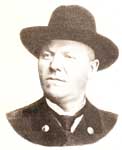 LIEUT. HENRY BAHE
Abrupt of speech and extremely loath to use the fair records of his own life as subject-matter, Lieut. Henry Babe is known throughout St. Paul as one of the largest hearted, most whole-souled men within its boundaries. He is liked by young and old who have grown to realize that his habitually dignified, grave demeanor is but a mash to hide the depth of feeling invariably aroused by the sight of suffering. Physically, Lieut. Babe is a splendid type, and his courage and pluck are fully in keeping with the massive strength which has stood him in such good stead for fifty years of life. Just so many have passed since his birth in Hessen-Cassel, Germany, but one needs to be told it by the lieutenant himself in order to believe it. He was educated in the state schools of his native land, and when sixteen came to Minnesota, locating on a farm in Woodbury, Washington Co. After five years he settled in St. Paul, going into the express business. At this time, in 1872, he was married to Miss Rosina Lindig, the daughter of a prominent pioneer resident of the city. In 1875 he received his appointment to the force from Mayor Maxfield. There were only twenty-five men on duty then, and a patrolman's beat was not a "snap job" by any means. In April, 1890. Lieut. Babe received his present title, after having been acting sergeant for some time.
He was installed at the Rondo st. Sub-station, remained there a little over five years, and after three months at the Margaret st. Sub-station, assumed his present position. One of Lieut. Bahe's most vivid recollections of arrests while in the patrol service is of "Sheeny George," who within one hour of reaching town stole $300 worth of furs from Albrecht's store.
The sight of "Prussian Frank" with his teeth knocked out, lying stretched on the floor of the Rondo station, pockets full of silver from the Anheuser-Busch Brewing Co.'s safe and blood oozing everywhere is another one of a kaleidoscope of stirring memories.
Lieut. Bahe says, however, that he would rather deal with a male prisoner any day than with a frantic woman, which ought to be flattering to the men, to say the least. He lives at 159 Carroll st.
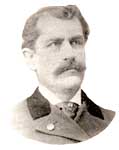 LIEUT. ERNEST BOERNER
During the late war with Spain some of the highest positions of trust were held by men of German birth or ancestry, who knowing the value of implicit obedience and rigid discipline in time of danger, never hesitated to act for their adopted country in precisely the same spirit of loyalty as that which might have animated them years ago, when the Fatherland was threatened with disruption. A man of this character is Ernest Boerner, lieutenant of the Central Station. Tall and erect and of an extremely dignified bearing, he looks the military man of a past decade to perfection. He is a fine looking man, too, and wears his uniform with a grace and ease known only to long possession. The lieutenant was born in Berlin, Germany, in September, 1850. His father was a man who had served with high honors in the German army, later becoming a government employe. At the time of the lieutenant's birth he was a captain of police, which latter position he held thirty-seven years. Lieut. Boerner is now the proud possessor of many medals conferred on his father, one of them being for fifty years government service.
The education of the young Boerner began when he was a mere child and ended with his graduation from a polytechnic institute as a full-fledged architectural draughtsman. In 1867 he came to the United States and for a time pursued his chosen avocation, but imbibing the warlike spirit which still lingered in the atmosphere, he became a soldier, and served in Kansas, Colorado and New Mexico for a period covering twelve years. The greater part of this time he was post commisary sergeant. Late in the seventies he engaged in business in Gunnison, Colo., and in 1881, located in St. Paul, where he was employed as bookkeeper by Commisary General Morgan. He received his appointment as a patrolman in 1882, and for the succeeding five years served alternately as patrolman, roundsman, acting baliff, and acting secretary to the mayor. Then, on May 1, 1887, he was promoted to the position of sergeant, and assigned to the Rondo St. Police station. In Dec. 1892, he became a lieutenant and in January, 1893, a captain, but in 1894 was reduced to the rank of sergeant. Two years later he received his present position as the lieutenant in charge of the central station during the day.
Needless to say, Lieut. Boerner has won a splendid record during his seventeen years of service. With a thoroughly competent chief at its head, and such a man as lieutenant Boerner in charge of its principal station, the police department of St. Paul need not fear the rivalry of any other city of its size.
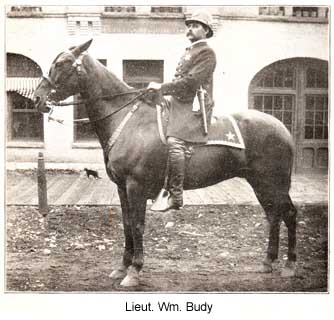
LIEUT. WM. BUDY
As the leader of every patrol of mounted police which has taken part in the street parades of the city of St. Paul, since 1885, Lieut. Wm. Budy will long be remembered by the multitudes assembled on these occasions. Always a man of commanding appearance, his attitude while on horseback is strikingly handsome; a combination of manly strength and perfect horsemanship which must elicit universal admiration. He is of German parentage and is now in the prime of life. When eighteen years of age, Lieut. Body enlisted as a private, in Co. F, 7th U. S. Infantry, and had an encounter with the Sioux Indians, in September, 1870, to record as one of his first adventures. Before being transferred to Fort Snelling, in 1878, Lieut. Budy had served successively at Fort Steele, Fort Buford, Fort Shaw, and Fort Benton, and had won the rank of 1st Sergeant, and acting post quarter-master. While in Benton in 1876 he married an English lady, born on the Isle of Jersey and the daughter of an army officer who fell at Gibralter. Shortly after being installed at Fort Snelling his company was sent to White River, Colo., where the Ute expedition was being organized. Active participation in the latter closed Lieut. Budy's career as a soldier, discharge from the service being given him in February, 1880. During his ten years enlistment he had seen every phase of Indian warfare and great loss of life, notably at the battle of Big Hole, which occurred in August, 1877, without himself sustaining serious injury.
Lieut. Budy was made a patrolman June 23, 1881, serving four years in that capacity. He was acting sergeant of the mounted patrol for two years before being promoted, on May 1, 1887, to the rank of sergeant and assigned to the Prior av. sub-station.
In 1889 he assumed his present duties as lieutenant of the same station. Since then he has made many arrests of offenders who were bound over to the grand jury, and though the neat little station house was at first the center of a somewhat desperate element, none of the captures made have required quite as much strength as did the arrest of a man named Schneider, early in 1882, and also early in the lieutenant's police career. The narrative of the tussle in which Lieut. Budy lost all his buttons, and his star, is thrilling. Lieut. Budy's narratives are all thrilling, for that matter. He is a brilliant racontuer and invariably at his best while relating one of the many hairbreadth escapes he has had while out on the plains.
As is quite natural, he is a lover of fine horses and has ridden his present saddle horse seventeen years. Another horse in his service is twenty-two years old and still quite active.
Lieut. Budy is a member of the following secret societies; Hermann's Sons, Lodge No. 24; Army and Navy Union, Gen. Wesley Merritt Garrison, No. 58; Knights of Pythias, Champion Lodge No. 13; Royal Arcanum, Merriam Park Council, No. 186, and The Teutonic Society. Lieut. Budy resides at No. 1909 Carroll st.
JOHN W. COOK
Was born in Ireland in 1847. He was appointed to the force Jan. 1, 1878, and is now doing duty as lieutenant at the Ducas Station.
WM. HANFT
Was born in Ohio in 1853, and was appointed to the force Jan. 4, 1875, and is now doing duty as lieutenant at the Rondo Station.
 LIEUT. HENRY J. POTHEN
Is truly a Junior Pioneer. Forty years ago and during the civil war his father drove one of the first stages ever taken out of St. Paul. His mother was of French-Canadian parentage and was brought to St. Paul by her parents when a child of two in 1846, the journey from Canada being made by ox-team. The lieutenant was born on a farm embracing much of what is now the Fort Snelling boulevard, thirty-one years ago. He was a school-boy until 1887, when he engaged in the hardware business. Jan. 1, 1890, he entered the police department, served three years and was detailed as a detective three more. In July, 1895, he became a sergeant at the Central Station, and the following year received his promotion to his present position. Since then he was twice injured by criminals resisting arrest, but as a matter of record has never had occasion to shoot a man in effecting a capture.
Lieut. Pothen is black-haired and black-eyed, of very pleasant address, and quiet undemonstrative disposition. Native energy and caution have done much toward placing him where he is and with his youth and strong physical constitution at command, he bids fair to climb still higher on the department ladder. Like Alexander of old Lieut. Pothen loves a good horse and owns several. He annually makes entries at the state fair and is seldom amiss in his judgment of "thoroughbreds." One of the latter, Hammont, has been on the track three or four years, and is a popular favorite. He resides at No. 189 Edmund st.
 LIEUT. JOHN A. SHOGREN
A lieutenant at twenty-five! strong, healthy and handsome besides, surely it would seem as if John A. Shogren has much to be thankful for. He was born and brought up in Chicago; came to St. Paul in 1890, and for five years was employed in a local flour and feed store. When twenty-two he joined the rank and file of the police department, and two months after his appointment, in August, 1896, was transferred from the Central to the Margaret st. district. August 18, 1898, he received his commission as lieutenant. During the spring prior to his promotion Lieut. Shogren made several very important arrests, one being of two highway robbers, Pat Hussey and Jim Dugan, who held up a man on the well-lighted corner of 7th and Sibley streets, at about 8 o'clock in the evening. Lieut. Shogren and officer Gates caught them in a saloon an hour and a half after the robbery had been committed. Another time he arrested a clever forger who had been trying to pass spurious paper in several Arlington Hill's business houses. A description had been furnished and from that he traced the whereabouts of the man, who was with difficulty taken to the station. Lieut. Shogren is married and lives at No. 677 Jessamine st. E.
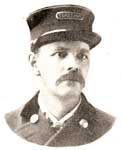 SERGT. PHILIP J. ARNOLD
Half a century ago what is now known as University Avenue was commonly designated as "the territorial road" and then as now, was the principal thoroughfare between the Twin Cities. On this road and on what is now the junction of Broadway and University av. Sergt. Philip J. Arnold was born, thirty-nine years ago. His father, Jacob Arnold, was the first dairyman in St. Paul and for many years did a flourishing business, supplying not only the village, but wandering cattle drovers and Indians with milk. Tepees then lined the prairies between St. Paul and Minneapolis and from 70 to 90 gallons of milk were daily consumed. While yet a little fellow, young Arnold became a scholar in the German Lutheran school and one of his most vivid recollections is of a daily run to town through a most dismal tamarac swamp. Later he attended the Madison School, and on finishing there assisted his father in the dairy business. When he was twenty-one he became a grocer, locating on the corner of University av. and Mackubin sts. In 1886 he married a St. Paul lady and subsequently kept a railroad hotel until his appointment to the force, Aug. 22, 1888, as a mounted patrolman at the Prior av. sub-station. His promotion to his present position occurred Oct. 21, 1896. In April, 1895, Sergt. Arnold received a bad cut in the head while making an arrest. Of a quiet, unassuming disposition and a frank, intelligent countenance, he is generally well liked and deservedly popular. He is a member of the A. O. U. W., Junior Pioneers, Teutonic Society and Sons of Hermann. He lives at 523 Sherburne av.
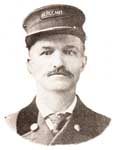 SERGT. JOSEPH F. DAVIS
Twenty years ago when the entire Northwest was threatened by the Indian wars then raging, tales of thrilling experience, close at hand were quite as common as Philippine literature is now, Sergeant Joseph F. Davis as one of the survivors of that dread period can point with pride to a record filled with feats of daring bravery. A Dative of Bohemia, and forty-two years of age, he came to this country when a child and was educated in the private and public schools of Cleveland, Ohio. Later he acquired the trade of a cooper but left it to enlist in the U. S. army at the age of twenty. From the Columbus barracks he was transferred to Fort Snelling, and soon after became a member of Co. A, 5th Regiment Mounted Infantry, then commanded by Col. Nelson A. Miles, and stationed at Fort Keogh.
In March, 1878, Sergt. Davis took part in the first expedition sent out to surround the Indians, under Chief Gall, and from that time until Dec. 17, 1882, when he was honorably discharged, he fought in innumerable skirmishes. Among the last of these was an encounter at Poplar, River, near old Fort Peck, in which sixty-five wigwams were destroyed and about seventeen hundred savages taken prisoners. The honor of escorting the captured Indians to Fort Yates, Dak., was given to the companies participating in the engagement.
Shortly after his discharge, Sergt. Davis came to St. Paul and was given the position of turn-key at the jail. Resigning in 1886, he was appointed to the police force by Mayor Rice, receiving his promotion as sergeant of the Central Station in June, 1896. He is a member of General Wesley Merritt Garrison of the Army and Navy Union, U. S. A. and the Bohemian order C. S. P. S. He lives at No. 407 Superior St.
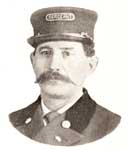 SERGT. MICHAEL GEBHARDT
Sixteen years of continuous service have made Sergeant Michael Gebhardt every inch a veteran in the faithful performance of duty. And yet he has hardly passed the summer of life, being only forty-four years old. Sergt. Gebhardt hails from Alsace-Loraine, now a province of Germany, and was educated in the public schools of his native land.
When seventeen he began working as a teamster for the St. Paul branch of the Standard Oil Co., and later on was given a position at the Ramsey County Poor Farm, of which Nicholas Pothen was then superintendent. In 1883 Mayor O'Brien appointed him to the Central Station, the only one at that time. With the opening of the sub-station on Margaret st. he was detailed as driver of the patrol wagon there. Five years later he was made a detective and shortly afterwards, on August 15, 1896, was promoted to his present position as sergeant. Mr. Gebhardt is married and has a large family of sons and daughters. He lives at No. 1148 4th st. E.
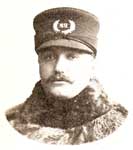 SERGT. CHARLES H. GERBER
A single glance at the regular determined features and strong physique of officer Charles H. Gerber must suffice to show that he possesses elements which make an ideal patrolman. He is as yet a young man, only twenty-eight, but this is his third year of service. St. Paul is his birthplace and he received his education in the city schools, later on engaging in the grocery business. He became a member of the force Aug. 3, 1896 and was assigned to the Rondo st. Sub-station where he is at present. He was promoted to sergeant March 8, 1899.
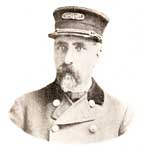 SERGT. OLUF LARSEN
In Throndhjem, on the Throndhjem Fjord, which winds inland between the towering cliffs and rocky highlands for which Norwegian scenery is justly famous, a boy's first knowledge of life is gained on the water. School-books and fish-nets bear a very close relationship in those far Northern climes; indeed, as Sergt. Oluf Larsen puts it, "a boy's school is on the sea." He was born mid all the grandeur of the upper coast of Norway, fifty-two years ago, and when only eleven years of age became a sailor on a merchant vessel. It was a pleasant life, full of excitement and adventure and young Oluf bade fair to continue in the calling of a ship-carpenter indefinitely. But one day, while cruising along the English channel, his elder brother who had been his protector on many a rough and stormy voyage, fell off a rigging and was picked up dead on the lower deck. This sad occurrence put an end to the younger Larsen's sea-life for all time. He was then a youth of twenty-two and in the search for a haven of forgetfulness. America became his first thought. Emigrating first to Chicago and later to St. Paul, he settled in the latter city as a carpenter and contractor. That was in 1869. In 1872 he married Miss Peterson of St. Paul, who became the mother of his seven children, and in 1881, on the first day of March, he became a member of the police force. There were only twenty-eight men on as regulars at that time and a beat in one of the lower town precincts was far harder to control than it is now. But Sergt. Larsen did always his duty with rigorous precision, and what is more, intelligently, so that when, May 1, 1887, he received his promotion as sergeant of the Margaret st. sub-station, all his well-wishers were highly gratified and not even his enemies could deny that his elevation in rank was the reward of merit and well deserved. He lives at No. 788 Pine st.
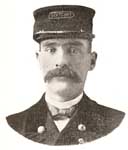 SERGT. DENNIS C. McCARTHY
Forty-three years ago, Sergeant Dennis C. McCarthy was an infant in Clahanaough, County Kerry, Ireland. He obtained a thorough education in the free schools of his native town, and on reaching manhood crossed the ocean, arriving in St. Paul during the Spring of 1879. The following six years he was a foreman for the Street Railway Company. May 1, 1887, he was appointed a patrolman and assigned to the newly opened Rondo st. Sub-station. In 1891 he was transferred to the Central district and for two years and a half was on duty at the Union Depot. His promotion to the position of sergeant occurred in June, 1896.
Sergeant McCarthy has enjoyed the best of health throughout his long service. He is a typical Irishman, witty and highly optimistic, with a rich fund of humor which never fails him.
In 1891 Sergeant McCarthy rendered splendid service while assisting Capt. — then Sergt. — Getchell in making the arrest of Prussian Frank, one of the most desperate criminals known to the Northwest. He is married and lives at No. 436 Fuller st.
SERGT. GUSTAF A. MALMQUIST
Is thirty-five years old and in his present position is an example of what energy and perseverance, allied to good common sense, can do toward elevating a man's station in life. When he came to St. Paul, from Sweden, in 1883, he worked as a private coachman, and later on, held a position as collector for a local business house. For two years previous to his appointment on the force he was a conductor for the street railway company. On March 24, 1893. he was assigned to a West St. Paul beat and five years later Mayor Kiefer promoted him to the position of sergeant. He is married and resides at No. 55 Colorado st. W.
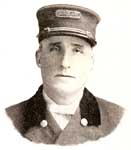 SERGT. ANDREW J. ROSE
The average old settler of either of the Twin Cities feels very safe in making the assertion that the coming half century can never bring about as many changes as the past one has. And as he says it, a half-sad, wistful-look comes into his eyes; he thinks of the time when a drive to St. Anthony or to Little Canada, or to Rose-town, did not mean a view of rows of houses. Rose-town used to be a thriving agricultural community, and received its name from its principal farmer, the father of Sergt. Andrew J. Rose. The sergeant went to live there when a baby, and there too, he attended the three-months-a year district school. He is now fifty-two years of age and never so happy as when recalling some of the scenes of a long-vanished past. When 14 years old he went to live in Cottage Grove, Minn.; married Miss Mary Robinette of Mendota when twenty and in 1873 came to St. Paul. Miss Robinette was the daughter of Joseph Robinette, a government blacksmith, who was killed during the Indian outbreak in Redwood Falls, in 1862. Sergt. Rose has a large family, thirteen sons and daughters having been born to bless his early union, three of whom died in infancy. Upon coming to St. Paul he worked at railroad grading for a short time, and later did general teaming. When the city workhouse was opened he served as a guard there for a year. In December, 1883, he was appointed a patrolman and walked a beat down in "lower town" nine years and a half. Then, in April, 1893, he received his promotion as sergeant of the Rondo st. Sub-station. During his long career Sergt. Rose suffered real injury only once and that a permanent dislocation of one of his fingers. He was assisting an officer in making the arrest of the notorious Spot" O'Connell and accidently received a blow from the officer's club. Sergt. Rose is the personification of kindly simplicity, a true American of the old school and to know him is to like him. He resides at No. 397 Martin st. Since the above was written he was attacked by a crowd of toughs on June 24 and seriously injured.
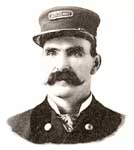 SERGT. JAMES T. ROSS
Is a Scotchman and forty-one years of age. Receiving a common school education in his native city he became an attendant at the Murray Flats asylum in Glasgow, and remained thus occupied three years. At twenty-one he determined to try a newer field for the display of all the innate energy and strong Scotch pluck which he possessed, and crossing the ocean landed in Quebec. Later on he went to Duluth and from there to St. Paul, where he settled down as a blacksmith. In 1885 he left his forge to join the ranks of the police department. He was promoted to the position of sergeant at the Rondo Station. Serving two years he was transferred back to the Central Station, where he is now. He resides at No. 261 Thomas st.
WM. RYAN
Was born in Ireland in 1867. He was appointed to the force May 20, 1893, and is now doing duty as sergeant at the Ducas Station.
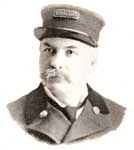 SERGT. REUBEN A. WRIGHT
Of all the city "blue-coats" there is not one better or more widely known than is Sergt. Reuben A. Wright, of the Central Station. He is well liked everywhere, and deserves to be, for he is a man of extreme good nature and more than ordinary intelligence. He was born near Decatur, Ill., in 1851, and in 1855 came to Red Wing, Minn., with his mother. This lady, Mrs. Amelia Wright, was one of the pioneer heroines of whom Minnesota must justly feel proud. Settling on an untilled farm a widow with ten children, not one of whom had reached maturity, she managed to rear and educate eight of them, two little ones being struck by lightning the summer after they came to Minnesota. The present sergeant received his schooling in Hamline University, then situated in Red Wing. Between times he worked on his mother's farm, and did not leave it until 1880, when he came to St. Paul to live. During the next two or three years he worked for a grocery firm and as a night watchman for a local wholesale house. Jan. 1, 1883, when Mayor Rice was at the head of the city government, Reuben Wright was appointed a patrolman. Before receiving his commission as sergeant in April, 1893, he was acting sergeant for half a year, and connected with the Margaret st. sub-station. In June, 1894, he resigned but was re-appointed two years later, resuming his former post of duty. From August, 1896, until March, 1899, he was stationed in the Rondo district. Now he is desk sergeant of the Central Station. During his long police career Sergeant Wright has seen crime in its very worst and crudest stages; he has also had the satisfaction of noting to what extent efficient service and conscientious attention to duty can help a city to become a model municipality. He lives at No. 286 Virginia av.
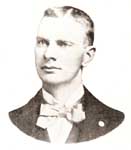 HANS AAMOLD
Was born in Rushford, Minn., twenty-nine years ago. In 1882 he came to St. Paul and during the next six years worked as a private coachman. July 2, 1890, he joined the rank and file of the police force and was detailed as driver of the Margaret st. patrol wagon. Two years later he was transferred to the Central Station and for three years drove the patrol there. Now he is walking a beat in the Margaret district and is a popular favorite with all who know him. Officer Aamold has always enjoyed the best of health and with the exception of an injury to his right side received in a fall from the wagon has never been hurt while on duty. At that time he did not allow the accident to interfere with his daily work. He is married and lives at 707 Minnehaha st. E.
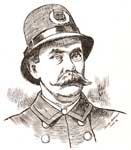 CHARLES ANDERSON
Was born in Sweden thirty-two years ago, coming to the United States in 1870. The first location chosen by his parents was Andover, Ill., where they lived seven years. During the four years spent in Stockholm, Wis., he attended public school, proving himself a bright and diligent pupil. Later on, in St. Peter, Minn., he completed his education and in 1881 began work in a St. Paul sash and door factory. Mr. Anderson remained in this position until Feb. 12, 1897, when he was made a patrolman by Mayor Doran. In April of the same year he was transferred from the Central to the Margaret st. Sub-station, where he is still serving. Officer Anderson is able to boast that he has never lost time by a single day of sickness or suffered any injury while on duty. He is married and lives at 670 Lawson st. E.
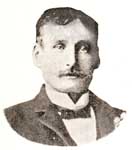 GUSTAVE W. BATHKE
Is one of the latest additions to the force, but if reports speak true, a valuable one. He was born in Germany thirty-four years ago. When twelve years of age his parents emigrated to Minnesota, settling on a farm near Glencoe, Minn. Later on they removed to Henderson and young Bathke remained with them until he was twenty-two. Then he came to St. Paul and drove an ice wagon three years, subsequently engaging in the milk business for himself. After a seven year struggle his comfortable home and dairy was destroyed by fire and he obtained work in a wholesale commission store. On April 27, 1899, he was appointed a patrolman in the central district.
Officer Bathke was married to Miss Annie Smith in 1890 and is the father of two bright boys and lives at 488 University av. W.
EDWIN L. BAUMGARDNER
Hockinpost, Ohio, is the birthplace of Edwin L. Baumgardner, present conductor of the patrol wagon at the Central Station. He is forty-three years of age and has made his home in St. Paul for the past seventeen years. At one time he was street inspector, succeeding by dint of strict attention to all details connected with the work, in holding this position for five years. Mr. Baumgardner was appointed a patrolman Aug. 10, 1892, serving in this capacity until the fall of 1896, when he became conductor of the Central patrol wagon. He is married and lives at No. 906 Burr st.
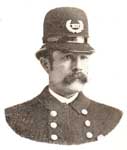 CHARLES BEATTIE
Among the Scotch recruits to the police service of St. Paul is Charles Beattie, who during forty years of life has had a career of adventure seldom outrivalled by fiction. Coming to New York in 1874, he worked in a meat market for a few months, going from there to Janesville, Wis., and later on to St. Paul. Catching the mining fever, just then at its height, Mr. Beattie went to the Black Hills as a prospector and succeeded in locating a promising claim. Tiring of continual waiting for developments, he abandoned it, but hardly had he done so when it was sold by his successor to an English syndicate for a fabulous sum. He returned to Scotland in the fall of 1882, only to return to St. Paul the following spring. Engaging in a live stock venture he made another voyage across the ocean to Liverpool. Stock raising on our western wilds had, however, far more attraction for Mr. Beattie than life in a quiet European port, and his two next moves were successively to manage large ranches, one near Tongue River, Mont., and the other at White Bear Lake, Minn. At the latter place, a stock farm belonging to A. K. Barnum, he remained four years. Five years in the livery business followed. On July 3, 1893, Mr. Beattie was made a patrolman and assigned to the Rondo St. Sub-station. He is married and lives at No. 9 Arch St. E.
AUGUST BOESEL
Is a German, aged thirty-five. As he himself says, "he was raised on a farm in Germany," and this fact does much toward accounting for the rugged strength and sturdy faithfulness with which he has always performed every duty, however minute, while on the force. He came to St. Paul in 1880 and was at one time a motorman in the employ of the Twin City Transit Co. Oct. 24, 1896, he was appointed a member of the police department, and has since served at the Rondo st. Sub-station. Mr. Boesel is married and resides at 527 Charles st.
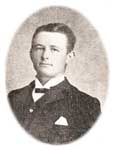 EDMUND BRAAK
One of the most highly esteemed mounted officers on the force is Edmund Braak, who is only thirty-two, but whose career reads like a tale of modern realistic fiction. He is a native of Marne, Germany, and has lived in this country just half his life. On May 7, 1884, he became a U. S. cavalry man, enlisting in Troop G, 4th Cavalry, and serving in New Mexico and Arizona during the time Geronimo, the Apache chief, held sway there. For nearly a year and a half, beginning with May 19, 1885, the little company of which Mr. Braak was a member, remained camped on the sage-brush plains without seeing a human habitation, or catching a glimpse of a "paleface." Geronimo had hardly surrendered and been escorted to headquarters, however, before Apache Kid began to be troublesome. And from that time on until Officer Braak's discharge in 1889 he led Uncle Sam's boys a mad chase. Seven days after leaving the 4th Cavalry, Mr. Braak re-enlisted in Troop G, 1st Cavalry at St. Paul and joined several expeditions against the Cheyenne Indians, receiving promotions to corporal and sergeant in rapid succession. His last campaign was against the Sioux Indians, and its close was marked by his being made regimental color bearer and drillmaster for the troop. Upon receiving his discharge as sergeant in 1892 he returned to St. Paul and went to work for the Twin City Rapid Transit Co. In December of the same year he was appointed a mounted patrolman and assigned to the Midway district. During the summer of 1894 Officer Braak met with an accident which well nigh proved fatal while arresting a negro on the State Fair grounds. With this exception he has never suffered injury. He lives at No. 435 Fairview av. N.
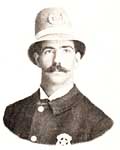 FRANK BRANCA
Is a young Italian, tall and slender, and of a dignified demeanor well calculated to command respect from even the "toughs" who infest his district. He belongs to the Central Station. Mr. Branca came to St. Paul in 1892 when twenty years of age and engaged in railroading. In March, 1897, he became a patrolman, and on Dec. 20, 1898, a benedict. In July, 1898, while arresting several notorious characters he was struck by a rock and severely injured, but has not encountered any difficulty since then.
He lives at No. 315 7th st. E.
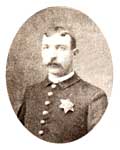 THOMAS J. BRENNAN
Irishmen proverbially make good policemen, and Officer Thomas J. Brennan is no exception to the general rule. Born in Ireland thirty-seven years ago, he came to this country when a mere boy, locating in Trenton, N. J. Aside from a trip to his native land, Trenton was his home until 1882. During that year he began work in a St. Paul stone quarry. Five years later, in 1887, Mr. Brennan became a police officer, and was assigned to the Rondo st. Sub-station, where he is still serving. Mr. Brennan has taken part in a great many encounters with desperate criminals, notably the arrest of three notorious characters, White, Dougan and Fisher, sentenced to Stillwater for life on the charge of murder. He is married and lives at 894 Albemarle st.
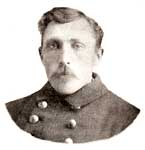 HERMANN BUNDE
Was born in Germany twenty-eight years ago. Coming to St. Paul in 1886 he worked for some time as a delivery boy before acquiring the trade of a bricklayer. Eight years of arduous toil in his chosen avocation followed. On July 18, 1898, Mr. Bunde became a patrolman, and was detailed to the Rondo st. Sub-station, where he is now serving. He is married and lives at 734 Lafond st.
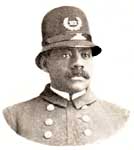 JAMES H. BURRELL
Although race distinction has not so far penetrated the St. Paul police service, James H. Burrell is at present the only colored man employed on the force. He is thirty-five years of age, and was born in Monroe county, Alabama. Previous to his appointment as a patrolman, Oct. 25, 1892, Mr. Burrell worked for the Pullman Car Co., holding the position of a porter four years. As a police officer he has served continuously at the Rondo st. Sub-station, winning the respect and confidence of his colleagues and the unstinted praise of his superior officers by his faithful and meritorious performance of duty, at all times. Officer Burrell is a single man and lives at 443 Rondo St.
WILLIAM H. BYRNES
The driver of the Ducas st. Sub-station patrol wagon, was born in Byrnesville, Dakota county, Minn. He is thirty-one years of age. Coming to St. Paul in 1890 he worked as a coachman and collector until June, 1896, when he was made a member of the police force. After four months of good service he was removed from his beat and installed in his present position as driver of the patrol wagon. Mr. Byrnes is married and lives at 407 Robert st. S.
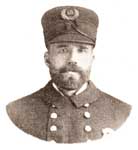 JAMES CAREY
There are men so diffident and modest that to recall even a praiseworthy record for publicity is a hardship. Such a man is Officer James Carey, an "Irishman" born in Scotland, who has been on the force sixteen years. He was a stationery engineer in the old country, and coming to St. Paul in 1876 plied the same profession for a number of years. Later he worked in the N. P. freight department four years. During the administration of Mayor O'Brien, in 1883, Mr. Carey was assigned to his present post at headquarters. Though not a man of powerful build, he enjoys extremely rugged health, evidenced by the fact that in the course of sixteen years he has never been seriously ill. He lives at No. 213 Charles st.
PETER CARROLL
Was born in Ireland in 1860. He was appointed to the force May, 1887, and is now doing duty as a patrolman at the Central station.
DANIEL J. CASHMAN
Is one of the younger members of the force, as well as being comparatively a newcomer. He is twenty-eight years of age and was born in St. Paul. His principal occupation previous to his appointment by Mayor Kiefer was that of a switchman on the various lines of railway centering in the Capital City. Officer Cashman donned his buttons Aug. 18, 1898, as a member of the Margaret st. police contingent. He is unmarried and lives at 278 Commercial St.
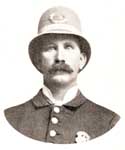 EDWARD CHRISTIAN
That little Holland has not been remiss in furnishing the department with a representative is evidenced by the genial presence of Officer Edward Christian at the Central Station. He was born in 1860 and came to this country when a child. His residence in St. Paul dates as far back as 1874, when he began to follow his trade as a bricklayer. Mr. Christian was appointed a patrolman at the Margaret st. Sub-station Jan. 27, 1889. In 1892 he resigned, resuming his former occupation. Three years afterward, in Jan., 1895, he was reappointed to the Central Station, where he has since remained. Officer Christian is married and lives at No. 266 Carroll st.
JOHN CASSERLY
Is a native of Morristown, N. J., and forty-two years old. Previous to joining the force he was a railroad and steamboat hand, also a government teamster at Fort Assiniboine, Mont. May, 1887, he became a patrolman and has since answered roll call at the Central Station.
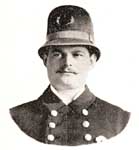 AUGUST CHRISTOPHERSON
Among the younger officers at the Central Station is August Christopherson, a native of Sweden and twenty-nine years of age. Mr. Christopherson did not come to America until he was sixteen years old, and then located in O'Brien county, Iowa, working on a farm in the summer and going to school during the winter months. In 1888 he settled in St. Paul, following his trade as a blacksmith. He became a patrolman July 20, 1896. Mr. Christopherson is a married man, and resides at 232 Charles st.
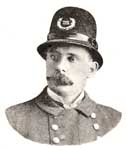 HARVEY D. CLINE
Officer Harvey D. Cline, of the Central station, was born in Erie Co., Penn., and is thirty-four years of age. Like many other progressive young Americans, he began taking care of himself at an early stage of his career, by driving a bus for a hotel in Bradford, when between fourteen and fifteen years old. Later he worked for a cattle dealer and during his early manhood was a traveling salesman for a New York company. Coming West he engaged in the meat and cattle business at Morris and Paynesville, running shops in these towns for above four years, and after that traveled alternately for biscuit companies in Lincoln, Neb., and Minneapolis, his last move being to establish himself in his early trade as a wholesale meat dealer. He was appointed to the force in January, 1898, and assigned to the Central station, where he has made a good record. He lives at 231 St. Anthony av.
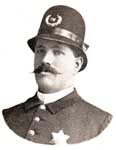 ANDREW COLL
A typical son of Old Erin is Officer Andrew Coll. "big Andy," to all those who know his kindly face and genuine Celtic humor. He has been on the force a long time, ever since June 17, 1883, and all of his early "beats" were confined to "lower town" in so much that his familiar figure, terrific to a wrongdoer, but infinitely attractive to all who appealed to its protecting strength, was missed for months after he was assigned to the Union Depot five years ago. Mr. Coll is still a young man, not quite forty, although his long residence in St. Paul, beginning in 1876, makes him seem a pioneer. At that time he was engaged in river driving and lumbering. He is married and resides at 420 Fuller st.
RICHARD CRONIN
Was born in Ireland forty-six years ago. In 1880 he located in St. Paul and worked seven years in one of the local wholesale houses. In 1887 he was appointed a patrolman, and assigned to the Central Station, where he is at present.
MRS. BRIDGET CUMMINGS
The matron of the Central police station is Mrs. Bridget Cummings, widow of Michael J. Cummings. She is a native of St. Paul and forty-four years of age. Mrs. Cummings was appointed matron May 15, 1892, but resigned during the next year. In 1894 she was reappointed and is still serving.
THOMAS M. CUMMINGS
Was born in Clinton county, N. Y., May 8, 1858. When nine years of age his parents settled on a farm in Rice county, Minn., and four years later he came to St. Paul, joining a party of Northern Pacific engineers there for an extended western trip. During the succeeding four years he caught a glimpse of life as it used to be lived on the plains of Montana and Arizona. Then he went south, but soon returned to the old homestead in Rice county. In 1886 he renewed his travels, going south again and later to the Pacific coast. While in Seattle he worked as a grip man for the street railway company. Going back to St. Paul in April, 1890, he was appointed a patrolman the following June, and assigned to the Rondo Station. Since then Officer Cummings has succeeded in establishing a record second to none in point of faithful adherence to duty. He lives at No. 605 Linden St.
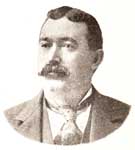 JOHN J. DALY
Among the officers on the force who were boys in St. Paul is John J. Daly, who has been a resident of the city all his life, a period of forty years. As a boy he learned the printing trade, working at it ten years, afterward becoming a locomotive fireman on one of the railroads running into St. Paul. When twenty-five years of age, in 1884, he was made a patrolman and assigned to the Central Station. In 1892 he received a well-deserved promotion to the city detective service. For eight months during 1894 he was jailer at the Central Station, later serving one year as inspector of pawnshops. On July 10, 1896, he was transferred to the Rondo Sub-station in the capacity of detective. Mr. Daly is married and lives at 212 Smith av. N.
EDWARD DELANEY
One of the "trusties" of the police service is Edward Delaney, who has been a patrolman for fifteen years, and during that time won the esteem of all his fellows by the faithful performance of duty. He was born in Ireland, May 12, 1847, and while yet an infant in arms was brought to New York by his parents. When four years old he was left fatherless, and shortly after came west with his mother, remaining in Elgin, Ill., two years and then locating in St. Paul. The family next removed to a farm in Scott county, Minn., young Delaney overseeing it until he was twenty, when he returned to St. Paul and became a carpenter. March 24, 1884, he was appointed a member of the police department and walked a beat in the Central district until 1892, when he was transferred to the Prior Sub-station as a mounted officer. Officer Delaney was married to Miss Mary A. Walsh in 1870, and is the father of eleven children, all living. They live at No. 320 Victoria st. S.
 TIMOTHY ENRIGHT
As a man with a splendid record and accounted one of the most efficient policemen in the Rondo district Officer Timothy Enright may well take pride in his uniform and the responsibility entailed by its wearing. He was born in Ireland thirty-nine years ago. When twenty years old he settled in Vermont, coming to St. Paul in 1883 as a railroad employe. Jan. 5, 1888, he became a patrolman at the Margaret st. Sub-station, later on being transferred to the one on Rondo st. He lives at No. 922 Woodbridge st.
 THOMAS FRANKLIN EUBANK
is one of the younger generation, a son of St. Paul, just a quarter of a century old. His father James Franklin Eubank, was a soldier of the rebellion, serving with a Wisconsin regiment from start to finish. Young Eubank attended the public schools in the Saintly City and was nearly eighteen when he began to make his own living as a clerk in a grocery store. After seven years of mercantile life Mr. Eubank was appointed a patrolman on June 5, 1899. Though so new to the service he is well liked and bids fair to become a most competent guardian of the peace. His marriage to Miss Jessie May Artis, of Portsmouth, Ohio, occurred June 9, 1896, and he lives at No. 165 Iglehart st.
 THOMAS R. FILLINGIM
Is a Canadian, forty-one years of age. He was raised on a farm near Montreal, going to school until the death of his father. This occurred when he was fourteen, and for nine succeeding years he was alternately a private coachman and the driver of a sprinkling cart. His first work on the force was as a special policeman at Grote's Tivoli for four years. March 30, 1887, he became a patrolman and was assigned to the Central Station, where he is still located. Officer Fillingim has rendered remarkably faithful service to the department, and has never lost time because of sickness or injury. He is married and resides at No. 686 Thomas st.
 JAMES W. FINN
Mounted Officer James W. Finn was born in New York, state forty-four years ago, but can safely be said to be western by habit and association, for he came to St. Paul when a year old baby, and later was brought up on a Minnesota farm. Subsequent to leaving school he learnt the trade of a carpenter and used it to good advantage out on the frontier during the six years following 1870. For three years he was an expressman in St. Paul. His appointment occurred April 30, 1884, and excepting the first year he was a mounted patrolman on Central duty until the opening of the Prior av. station. He has remained there ever since his transfer and is known as a thoroughly reliable, competent "guardian of the peace." He is a member of the Territorial Pioneers and enjoys a wide acquaintance throughout the Twin Cities.
He lives at No. 2108 Lincoln av.
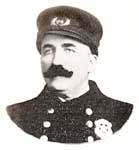 JOHN J. FITZGERALD
Was born in Galena, Ill., leaving there with his parents when a mere child. He is forty-two years of age, and a very well preserved man, twenty years of country life in youth having endowed him with a more than average complement of vigorous, health and hardy strength. In 1880 he concluded to leave the farm near Waukon, Iowa, where he was brought up and go west. Reaching first St. Paul, then Little Missouri, N. D., he went to work on a stock ranch. Afterward he secured a position as a locomotive fireman, and in 1885 was employed at shipping beef in Medora, N. D. From 1886 to 1892 he was a foreman in the supply department of the C., B. & N. Railroad.
In July, 1892, Mayor Wright appointed him a patrolman and assigned him to the Margaret st. Sub-station. He is married and lives at No. 891 Minnehaha st. E.
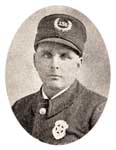 THOMAS H. FLYNN
In the summer of 1898 Mayor Kiefer organized a bicycle police squad and Thomas H. Flynn was one of its first members, the appointment coming as a promotion for good service rendered. Officer Flynn was born and brought up on a farm near Litchfield, Minn., and is thirty-five years of age. He learned the trade of engineer and followed the same for about five years. In Dec., 1897, he was made a member of the police force and assigned to the Central Station. Mr. Flynn is well liked in his district for his many admirable qualities of mind and heart but more especially for the consideration invariably shown the poor animals he has frequent occasion to defend. He lives at No. 327 Somerset st.
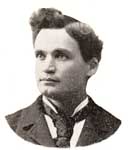 WILLIAM C. FORRESTER
In point of splendid physique and manly strength William C. Forrester is every inch of what a good policeman should be and although his time of service has been short, it has fully demonstrated his fitness for the position he holds. He is a native of La Crescent, Minn., and thirty-three years old. In 1892 he took up his residence in St. Paul and was shortly after appointed a guard at the Stillwater penitentiary. He remained there for five and a half years and then became a traveling agent for a surety company. On Aug. 19, 1898, he was appointed a patrolman and assigned to the Central Station. Officer Forrester is married and lives at 19 10th st. E.
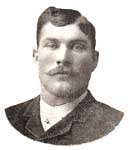 FRANK FRASER
Was born and educated in Cornwall, Ontario, Can. He is thirty-six- years old. Previous to his appointment as a patrolman, April 27, 1891, he worked two years as a gripman and three running an elevator. Mr. Fraser has made St. Paul his home for the past fifteen years and has a wide circle of friends in the community. In June, 1895, he was detailed as driver of the Central Station patrol wagon, but is now doing patrol duty. He is married and lives at No. 290 Charles st.
JAMES M. FURLONG
Was born in Dakota county in 1870. Upon completing his education at the age of eighteen he came to St. Paul and for the next ten years worked as a check clerk for the C. M. & St. P. Railway and the Winsconsin Central. Although a comparative newcomer in the department, having received his appointment in 1898, Officer Furlong is highly esteemed in that part of the Ducas st. Station district which he patrols. He lives at No. 217 Winifred st. E.
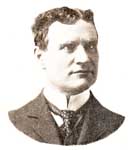 LOUIS J. GALVIN
One of the handsomest men in the service is Louis J. Galvin, who was a professional base ball player before he became a policeman, leaving the league only because of an injury received while pitching. Mr. Galvin is a native of St. Paul and was born in 1863. Upon leaving school in 1881 he worked as a railroad delivery clerk. While a baseball player he pitched successively for the New England, the Northwestern and the Eastern leagues. He was made a patrolman in 1887, and detailed for duty at the Central Station. After six years of service he resigned only to be reappointed in 1896. In Sept., 1897, he became a special detective and later on the jailer of the Central Station. He is married and lives at No. 331 Ramsey st.
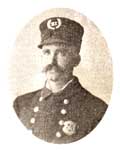 CHARLES H. GATES
Was born in Clinton county, New York, in 1861. From the age of six years to fifteen he attended the public schools in New York City. From the age of fifteen to twenty-one he was employed in his father's store as a clerk. At the age of twenty-one he located at Minneapolis, where he engaged in business for himself, remaining a little over a year, when he went to Chicago, remaining there five years, during which period he was employed as a conductor by the C. C. Railway Co., then he returned to the Northwest, stopping at St. Paul, where he was employed for five years by the St. Paul City Railway Co., as conductor and foreman, and on June 21, 1894, he was appointed patrolman on the St. Paul police force, being assigned to duty at the Margaret st. Sub-station. In 1898 he was detailed as day jailer at the Margaret st. Sub-station, which position he still holds.
Officer Gates is a brother of the well known physician, E. M. Gates, of New York City. Mr. Gates is married, and enjoys a well deserved popularity among his many friends and superiors in office. He resides at No. 402 Hope st.
JOHN GAUL
Was born in Cologne, Germany, in 1857. He was twenty-five years of age when he came to St. Paul. There he learnt the trade of a machinist and worked at it for eleven years in the Great Northern and Northern Pacific shops. In 1893 Mayor Wright made him a policeman in the Central district.
WILLIAM C. GAVIN
A young man of an exceedingly modest demeanor, a straightforward, open countenance and an unvarying cheerfulness is William C. Gavin, one of the mounted officers. He was born on a farm in Rice county twenty-eight years ago, and as a country boy trudged many miles each day to learn life's early lessons in a crude little country school house. Then, when he was nine his parents took him to Faribault and for four years he attended a parochial school there. At thirteen he came to St. Paul and learnt the trade of a machinist. Later he worked five years in the Great Northern shops, leaving them to become the driver of a beer wagon. Oct. 22, 1896, Mayor Doran appointed him to the force and he has been very active since then, making a most creditable record for himself out at Midway. Most of the arrests made there are for petty misdemeanors but once in awhile a real bad man invades the park precincts and has to be arrested. Officer Gavin made one capture of this kind when he arrested Marcus Thompson, a notorious crook, in July, 1898. Thompson was bound over to the grand jury, but fell ill while it was in session, and being confined in the city hospital, made a successful escape. He lives at No. 411 Snelling av. N.
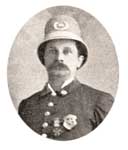 THEODORE GERVING
Was born in St. Louis, Mo., and is forty-three years old. Like many other mounted officers he gained his skill in horsemanship while a cavalryman. Enlisting in Co. 1, 1st U. S. Cavalry, April 12, 1875, he served for five years, and was honorably discharged in San Francisco, Cal. Coming to St. Paul, he worked in Elevator B as a fireman, and on April 1, 1887, was made a policeman. A month later, when a sub-station was given the Rondo district he was put on duty there. In August, 1892, he was promoted to the position of mounted patrolman at the Prior av. Sub-station. He is married and lives at No. 1139 Chatsworth st.
PHILIP R. GIBBONS
Was born in Ireland in 1842. He was appointed to the force in 1875, and is now doing duty as conductor of the workhouse van.
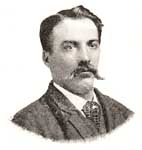 ALFRED GODBOUT
Was born in Canada forty-five years ago, coming to St. Paul in 1887. Previous to his appointment on the force he was in the commission business. June 13, 1896, he was given a beat by Mayor Doran and since that time has served continuously at the Ducas st. station. Mr. Godbout is widely known and highly respected over on the West Side, where he is a property owner. He lives at No. 251 Gates st.
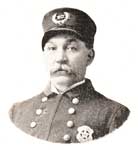 JOHN GOVEN
Is a native of Germany and forty-eight years of age. When a child of eight his parents located in Winona, Minn., and he was educated in the public schools of that city. Shortly after attaining his majority he was appointed deputy sheriff of Winona county, and held the position three years. After that a hotel in Red Wing and a saloon in St. Paul were successive ventures, followed by an appointment as assistant inspector of weights and measures. In 1887 he was made a patrolman and detailed to the Central Station. Officer Goven is not a tall man and of medium weight, but when it comes to dealing with a St. Paul thug the latter is not in it at all, as evidenced by two desperate encounters in which only a rare presence of mind, displayed in the capture of all firearms, saved his life.
Another very narrow escape from death occurred when the veneered front of a building fell on him, while on duty. As it was he received only a few slight bruises. He lives at No. 707 De Soto st.
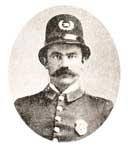 STEPHEN J. GRIEMANN
Choice of men according to nationality instead of fitness has never been a dominant policy of the St. Paul police department, as evidenced by the fact that it is an American institution in the largest sense of the word. Austria-Hungary is represented in it by Stephen J. Griemann, a comparatively young patrolman who has lived in St. Paul ever since he emigrated from Europe, eighteen years ago. He was then a boy of fifteen and a carpenter by trade. From 1882 to 1889 he worked at this and as a grocery clerk until he had amassed the means to start into the grocery business for himself. June 12, 1890, he was made a patrolman in the Rondo district. Mr. Griemann is a family man and a property owner, living at No. 630 Lafond St., and is universally esteemed throughout the 8th Ward, which he patrols, as well as by his superior officers.
JAMES J. GRIFFIN
Was born in Pennsylvania in 1852. He was appointed to the force in 1890, and is now doing duty as patrolman, at the Ducas station.
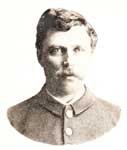 SAMUEL E. GUSTAFSON
Is a native of Sweden and thirty-five years old. He has lived in St. Paul for the past fourteen years, working as a warehouse man out at the Minnesota Transfer the greater part of the time. His appointment to the police force occurred Nov. 16, 1897, and he has served at the Central Station since that date. Officer Gustafson is commended alike by his superior officers and his colleagues for steady, unswerving loyalty to the star which decorates his uniform. He lives at 709 Pelham st.
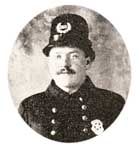 HENRY GYDESEN
Mayor Kiefer's first appointment to the police force was that of Henry Gydesen, who is only twenty-six years old. When a boy in Denmark Mr. Gydesen showed unseal ability as a scholar, graduating from a Latin school at an early age. Eight years ago he came to St. Paul, and after clerking two years, engaged in a grocery business of his own. Later he made a trip to Europe, remaining about a year. Mr. Gydesen became a patrolman in July, 1898, and was assigned to the Margaret st. Sub-station. When the bicycle squad was organized he was made a member and rendered effectual service in the rounding up of scorchers and sidewalk trespassers throughout the summer. He lives at No. 857 Minnehaha st. E.
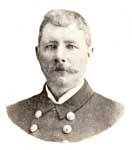 CHRISTOPHER J. HAGEN
Norway is the birthplace of Christopher J. Hagen. He is thirty-six years old and before coming to this country served four years on the police force of Christiana. In 1887 he came to St. Paul and worked in the Great Northern railroad shops for seven years. His appointment to the force was made Nov. 6, 1896, and he was then assigned to his present post in the Margaret st. district. Officer Hagen has been unusually successful in warding off attacks and the only real injury received while on duty was a cut on the head with a pick wielded by a local desperado. Within two weeks time he was able to be about again, much to the satisfaction of the residents of his district, by whom he is generally liked. He lives at No. 993 Payne av.
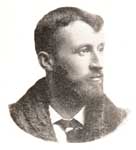 THOMAS E. HAGGERTY
Is thirty-three years of age, and was born in Rice county, Minn., where he received a common school education. Coming to St. Paul in 1885 he pursued his trade as a carpenter. July 20, 1892, he became a member of the force and was given a beat in the Rondo district. In December of the same year he was transferred to the Central Station, and assigned to his present position as driver of the patrol wagon. Officer Haggerty has a splendid record for steady, earnest attention to duty. He has always had the most faithful of dumb assistants in Roxie, a beautiful white horse, and the oldest in the service. Roxie has been on duty fourteen years. Mr. Haggerty lives at No. 158 Dousman st.
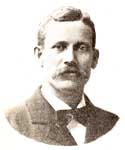 MILLARD F. HALLOWELL
It may be that a "nose for news" and Yankee blood are closely related. At any rate Millard F. Hallowell has both and so cannot quite help being the excellent detective he is. He comes of an old New England family and was born at the home of his grandfather in Augusta, Me., thirty-eight years ago. He received his education in Kent's Hill Seminary, and on leaving there settled in Boston, Mass. Later he came to St. Paul and at once entered the E. M. Hallowell Co.'s carriage factory as foreman, he being a nephew of the senior member of the firm. After thirteen years there he stepped into his present position June 6, 1896. Mr. Hallowell's duty is to receive all reports from outside stations and to keep track of stolen property entered in pawnshops. He has shown himself particularly expert in the handling of shop-lifters, in quite a number of cases. In 1898 Mr. Hallowell made a find of $1,700 worth of goods, and the minor cases of petty larceny ferreted out by him are well-nigh endless. Personally he is very agreeable and decidedly fond of outdoor exercise. He lives at 285 Sherburne av.
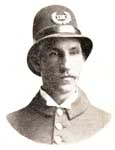 FRED W. R. HAMMERGREN
One of the younger patrolmen and a St. Paul boy is Fred W. R. Hammergren. Born in 1872, Officer Hammergren left school to become a printer, working at the trade for five years. After that he was a street car conductor, and in 1892 entered the St. Paul fire department as a truck and pipeman. Two years later he resigned and went to work for the Great Northern Railway. Nov. 9, 1896, he received an appointment as patrolman, and has since been on duty at the Central Station. Of a robust figure and energetic disposition, Mr. Hammergren is well fitted for all the exigencies of duty and during his patrol has never lost time because of sickness or injury.
He lives at No. 727 Fauquier st.
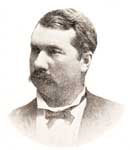 JOHN H. HARRIS
To John H. Harris, jailer at the Central Station, belongs the honor of having served his country when a boy. A Virginian by birth, he spent his early years in Ottawa, Ill., and when in April, 1863, the oft-repeated call for volunteers reached him, he enlisted as a member of Co. I, 138th Illinois Infantry. He was only sixteen then and was mustered out after a year and a half of camp life, serving voluntarily, however, until the close of the civil war in 1865, five months over his term of enlistment. After that he returned to his trade as a plowsmith, becoming manager in several instances before his removal to St. Paul in 1878. Taking charge of the St. Paul Plow Works, he remained nine years. During the boom in North St. Paul he was at the head of the Harris Mfg. Co. there.
Jan. 1, 1889, he was appointed a deputy sheriff and served three years and a half. In 1892 he served six months as a city detective, and in 1894 was awarded the contract for city street prinkling. He was given his present position in June, 1896. He lives at No. 456 7th st. E.
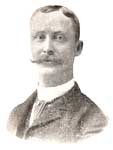 JAMES P. HEENEY
One of the latest, but by no means the least experienced appointees to the force is James P. Heeney, who was a city detective under the Wright administration, resigning at its close. His birth occurred at Cleveland, Ohio, in 1864. When a lad of five or six his parents removed to Pittsburgh, Pa., where he attended the parochial and public schools until he was sixteen years old. Then he became a cabin boy on a steamer which plied the Ohio river from Cincinnati down to the "Father of Waters." The year 1887 marked his coming to St. Paul, but not his stay, for he worked as a railroad news agent during the next two years. He was in the employ of the Pinkerton Detective Agency at the time of his first appointment. Later on he established himself as a private detective and was usually successful in the matter of shadowing suspicious characters. Although ranked as a patrolman when reappointed on May 6, 1899, he has since been on duty at the Central Station as a detailed detective and it is expected that his services will prove of value to the department.
JOHN A. HELMER
Was born in Sweden thirty-two years ago, emigrating to Minnesota when a boy of fourteen. His education was received in the Swedish public schools and later on at a St. Paul business college. For three years he worked on a farm in Meeker county and in 1886 became a lamplighter for the firm which then held the city lighting contract. After five years of faithful service he was made warehouse foreman for the same firm, continuing in their employ until July 1, 1897, when he resigned to become a patrolman at the Central Station. With the organizing of the bicycle squad he was made a member and transferred to the Ducas st. station. Though comparatively new to the service, Officer Helmer has already won a record for steady attention to duty. He lives at No. 80 Winifred st. W.
DAVID F. HENNESSY
Elgin, Ill., is the birthplace of David F. Hennessy, now a patrolman at the Central Station. Officer Hennessy has been fourteen years in the service of the city, joining the fire department in 1885, when he was twenty-three years old. During the next seven years he received successive promotions, holding the rank of captain at the time of his resignation in December, 1892. While a fireman Mr. Hennessy met with two accidents, necessitating nearly three months' sick leave. Within a few days of leaving engine duty he became a policeman, and a good one at that, winning a reputation for fidelity to trust throughout the district whicn he patrols. He lives at No. 193 University av. W.
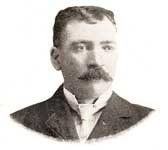 JOHN J. HENNESSY
A notable feature of the St. Paul police department is the aggregate number of strong men in its employ, men who are giants in stature and strength and who have never lost a day through sickness. Officer John J. Hennessy is one of these. A six-footer, and weighing two hundred and twenty pounds, it may be that he owes his rugged health to being born in Minnesota thirty-seven years ago. Early in life, after he had finished school, he became a stationary engineer and for many years worked in that capacity for various firms of St. Paul. During Mayor Smith's administration he was made a patrolman, but resigned to go into the flour and feed business. Nov. 13, 1894, he was appointed a second time and assigned to the Central Station.
He lives at No. 19 Prospect Terrace.
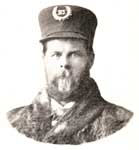 ANDREW S. HERVIN
Is of Norwegian parentage and was born in 1862. In 1882 he left his home across the ocean and settled in St. Paul, pursuing the trade of a carpenter. Ten years later, in August, 1892, he was given a beat and assigned to the Margaret station, a transfer to the Rondo district being made the same year. June 20, 1894, he resigned, but was reappointed in 1896, and detailed to the Central Station. It has been said of Officer Hervin that nothing doubtful can ever escape his untiring vigilance, backed as it is by the pair of gray eyes, clear and keen as the frosts of his own native Norway.
He lives at No. 568 Sherburne av.
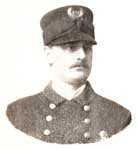 FRANKLIN HOEFER
Was born and educated in Galena, Ill. He is forty-four years of age. For the past fifteen years he has lived in St. Paul and with his family is widely known and well liked in the district which he patrols. Previous to joining the force he worked alternately as a night watchman and as a motor grip-men, holding one position in the last named capacity five years. He was made a policeman in 1891 and assigned to the Margaret st. Sub-station.
He lives at No. 1093 4th st. E.
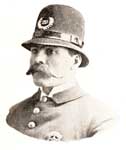 JAMES HOLLAND
Another of the strong men on the force is James Holland, who also claims Minnesota as his native state. Officer Holland was born in 1864, and came to St. Paul from Goodhue county when seventeen years of age. For a year he worked as a car builder in the C., St. P., M. & O. shops and then became a private coachman. Later he was a teamster for the street railway company, leaving his position there to take charge of a hack line for a local livery and after a time for himself. After twelve years of hack driving he became a patrolman in July, 1896, and was detailed to the Central Station. He has never lost time through sickness or accident and has an execllent record. He lives at No. 308 Carroll st.
CHARLES F. HOFFMAN
Was born in Iowa in 1862. He was appointed to the force Nov. 1, 1896, and is now doing duty as patrolman at the Ducas station.
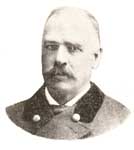 FRANK HORN
Almost within sight of the Fort Snelling reservation there is a picturesque cottage, surrounded by acres of velvety lawn and dense orchard growth. It is the home of Officer Frank Horn, who "holds the fort" at its bridge entrance and answers roll call by telephone. He is a Scotchman, born in Aberdeen, a little over fifty years ago. When a boy of thirteen he went to sea as a cabin boy on the "Jan Mayen," an old time sailing vessel. The whaler cruised between Peterhead, Scotland, and Greenland, and young Horn remained on board two seasons. Then he made several voyages to the Baltic sea and Odessa, Russia. Alexandria, Egypt, was also a regular port and on one trip the young sailor beheld the sights and Eastern magnificence of far away Calcutta. When twenty he came to the United States, and a few years afterwards took up his permanent residence in St. Paul. Previous to entering the police department, in October, 1890, he was employed as a shipping clerk by Auerbach, Finch & Van Slyke, carpet house for over a decade. His first police service was rendered in the municipal court, where he was bailiff. Two years later he was assigned to a patrol in the Central district. In 1893 he became desk sergeant, much to the edification of Sunday newspaper reporters, who accorded him the reputation of being a teller of sea yarns and police tales, second to none. It was only during the past year that Officer Horn was transferred to his post at Fort Snelling. He is a Mason of seventeen years' standing, belonging to Ancient Landmark Lodge No. 5.
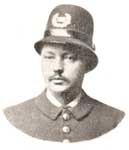 JOHN HOSCH
Twenty years ago, when a mere boy of fourteen, John Hosch left his home on a farm near Caledonia, Minn., and reaching St. Paul set bravely to work at winning a livelihood. For twelve years he worked as a sawyer in the employ of a wholesale wood and coal firm, later becoming a yardman for a retail fuel company. During the three years previous to his appointment to the force he kept a restaurant and still continues to run the same. He has been on duty at the Ducas Station since Aug. 19, 1898. Officer Hosch is married and lives at No. 350 Minnesota st.
JOSEPH HOUSKA
Was born in Le Seuer county, Minn, thirty-three years ago. Coming to St. Paul in 1876 he obtained his education at the Jefferson school. His first work was done in the pressroom of the Pioneer Press, where he was employed over four years. Subsequently he worked eleven years as a mailer for the Globe. In 1896 Mayor Doran appointed him to his present position as a patrolman in the Central district. Mr. Houska is married and lives at No. 161. Congress st. W. He is a man of splendid physique and excellent health, two qualities which have done much toward giving him a very creditable roll call record.
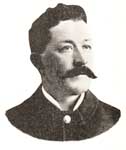 JOHN L. HUGHES
Was born in St. Croix county, Wis., and is in the thirty-third year of his age. He is a carpenter by trade and after coming to St. Paul in 1888 pursued this avocation, as a foreman for the most part. March 19, 1897, he joined the rank and file of the force and since then has rendered faithful service in that part of the Central district which he patrols. He is married and resides at No. 1597 Marshall av.
GEORGE D. HUTCHINS
Was born in Malone, N. Y., thirty-three years ago. For thirteen years after coming to St. Paul in 1886 he was a street car conductor. Then in August, 1898, Mayor Kiefer appointed him to the force and assigned him to the Margaret st. Sub-station, where he was detailed as driver of the patrol wagon, but is now serving as driver at the Central Station.
MARTIN G. IMHOFF
Was born in Ohio in 1852. He was appointed to the force April 5, 1889, and is now doing duty as patrolman at the Ducas station.
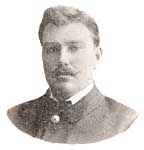 LOUIS JOHNSON
Is among the very latest youthful bluecoats appointed by Mayor Kiefer. He was born in Sweden, Aug. 6, 1875, and came to America, to Alden, Minn., when he was nine years old. A year after, in 1885, his parents removed to St. Paul, where he attended the public schools until he was sixteen. Then he became a delivery clerk and with the lapse of two years went to seek his fortune in Hillsboro, N. D. On returning to St. Paul in 1895, he engaged as a street car conductor and held that position until appointed to the force July 24. 1899, and assigned to duty in the Margaret district. He is a member of Minnehaha Camp, M. W. A., and a young man who has hosts of friends in the city. He lives at No. 899 Sims st. Officer Johnson died Oct. 27, 1899, since the above was written.
OTTO JOHNSON
It is hardly surprising to find a large per centage of the St. Paul police force of Scandinavian birth when one reflects that the brawn and muscle requisite to the making of a good policeman are largely a heritage of every Norseman. Officer Otto Johnson is of Swedish birth and thirty-five years old. He was a private coachman in St. Paul fourteen years before being made a patrolman, June 11, 1897. Since then he has served continuously in the Ducas street district. He is married and lives at No. 407 Robert st. S.
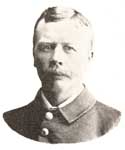 AMUND JORGENSON
Once upon a time, so say the legends, the name of Jorgenson belonged to a viking of so intrepid a mien that his approach spread terror along the shores of his enemies; today he has a worthy namesake, if not a descendant, in Amund Jorgenson, of the St. Paul police force. Though only thirty-five years of age, Mr. Jorgenson has had an eventful career. Upon leaving school he became a sailor, serving successively in the Norwegian, English and American navies for eleven years. In 1887 he came to St. Paul and worked as a mason for two years. Then he became a member of the fire department and was assigned to Engine Co. No. 8. After five years' service he resigned and returned to masonry. Aug. 18, 1898, Mayor Kiefer appointed him a patrolman at the Margaret st. Substation. He lives at No. 991 Payne av.
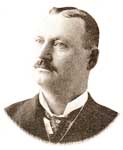 JOSEPH KEATING
The idea of a history of the Police Department which should embrace the lives of individual members is a new one, and credit for it is due a man who was himself connected with the force in days gone by — Joseph Keating. Ten years ago, when walking a Central Station beat, thoughts often entered his mind of how little the general public really knew of the police system, of the class of men who composed it, their habits, and their hardships. The publication, in 1899, of a book which contemplates acquainting the citizens at large with their protectors, not only against unlawfulness, but also against tire, is the culmination of the one central, long-cherished idea which germinated from these thoughts. As a municipal record it cannot other than prove invaluable. Although there is no department of the public service so highly interesting to every citizen, yet there is none of which so little is known.
Joseph Keating was born in Limerick county, Ireland, forty years ago. He was educated in the local private and public schools. In May, 1874, he came to the United States, and directly to St. Paul. Soon after he paid an extended visit to relatives in Scott county, Minn., and in 1879 engaged in railroading and lumbering in Minneapolis. In 1885 he returned to St. Paul, and during the next four years was employed as a car builder in the Great Northern railway shops. Then he became a patrolman in the Central district, serving two years. At the end of this time he resigned and subsequently worked for the "Soo" Railway as car inspector. In 1893 he entered the service of R. L. Polk & Co. as a solicitor. Three years later he re-entered the Police Department as night desk sergeant at Police Headquarters. When the position was abolished he was detailed on duty at Fort Snelling, and for some time did his best to guard the interests of "Uncle Sam's finest." He resigned for a second time in 1898, and since then has been actively employed in furthering the efforts of the American Land & Title Register Association to produce a publication which should fill an immediate need.
MICHAEL KIRCHMEIER
Was born in Hungary, 1860. He was appointed to the force June 20, 1894, and is now doing duty as patrolman at the Rondo station.
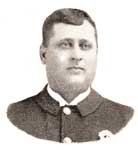 ANTON KOSTOHRYZ
"Tony," as he is generally known to his many friends, was born in Chicago, Ill., Sept. 24th, 1870. He obtained his education in the public schools and took a course in a business college. He is a Bohemian and speaks the German, Polish and Swedish languages. He came to St. Paul in 1876. He was engaged in the railroad business for thirteen years and has been employed as butcher and painter. Was for some time city salesman for the Spa Bottling Co. Officer Kostohryz joined the police force in 1898 and his record, though short, is a good one and he is very well thought of by the people living or doing business upon the beat he patrols as well as by the people in the neighborhood in which he lives. He now resides at 916 Watson av. He is also a popular musician.
EX-OFFICER JOSEPH KRIVANEK
Is thirty-one years old and came to St. Paul with his parents when a child of nine. Going to school here he afterward learnt the trade of a machine operator, working in one shoe factory seventeen years. Aug. 18, 1898, he was appointed a patrolman in the Central district. He is married and occupies his own property at 900 Armstrong av. He is not a member of the force at present.
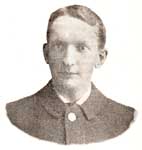 GEORGE F. KROEGER
Is one of the many young men appointed to the force by Mayor Kiefer, who evidently believes in giving youth a chance to win its laurels early in life. Mr. Kroeger was born Oct. 28, 1872, and is a St. Paul "boy," living with his parents in the house at No. 420 Eighth st., where he was born. Before being given his present position as conductor of the patrol wagon at the Central Station he worked as a clerk. He was appointed Aug. 19, 1898.
VALENTINE KRUSZEWSKI
Is forty-four years old and of Polish nationality. In 1874 he emigrated from the old country to Ontario, Canada, where he worked at the carpenter trade. Coming to St. Paul in 1880 he followed the same occupation until July 15, 1890, when he was made a patrolman in the Rondo district.
MARTIN KUETTEL
Hails from Switzerland, where he was born thirty-seven years ago. He received a partial education in the public schools of his native land and while yet a boy became a brewer, working thirteen years in one place. In 1883 he came to St. Paul and was employed in a local brewery nine years. Four years with a wholesale coffee house and two in a shoe factory completed his career as a private citizen. March 1, 1896, Mayor Smith appointed him to the Central Station. After a year and a half of faithful service he was transferred to the Ducas st. district. He is married and lives at No. 134 Ethel st.
ANDREW KUKLA
Was born in Poland before its division forty years ago. He has been twenty years a resident of St. Paul, coming to the city in 1879, and working at general railroading for six years. His appointment to the force occurred July 13, 1885. When the Rondo st. Sub-station was opened he was transferred there.
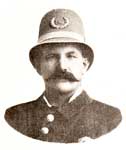 GEORGE W. LAMPE
Is a native New Yorker, but unlike many residents of the extreme East, he has learnt how to appreciate the far West by dint of much travel and varied experience. He is thirty-five years of age and has lived in St. Paul nearly eighteen years. By trade he is a brickmaker, and has been in business as a housemover. He has traveled extensively throughout the Western and Southern states and is a very well informed man. His appointement to the Central Station occurred Oct. 19, 1898. He lives at No. 705 Oakdale av.
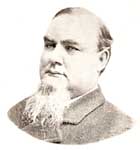 J. W. LAUDERDALE
A pioneer of St. Paul, as well as one of the earliest "city fathers" is J. W. Lauderdale, the popular veteran patrolman of the Ducas st. station. Augusta, Iowa, was his birthplace, and he was a slender stripling when he reached St. Paul in 1851. In 1885 he became a member of the common council. Previous to then he had been successively engaged as a steamboat pilot and captain, serving twenty-seven years in all: seventeen years on the upper Mississippi and its tributaries for Commodore Davidson, and ten years on the Red River of the North and the Saskatchewan river, and later became a retail grocer and a real estate dealer. He was appointed to the police force March 29, 1890.
Officer Lauderdale was married to Miss Medora A. Vincent, of Burlington, Iowa, in 1870. They have two sons and live at No. 220 Robie st. E.
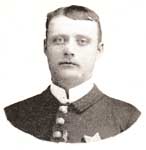 PETER LINDGREN
Were all the stories of injury received while on duty told they would make many pages of deeply interesting reading matter. And of this chronicle Officer Peter Lindgren, walking his beat in a dreary, desolate part of the city, could claim a conspicuous share. Of all his encounters while making arrests only two threatened to prove serious. One was a shot in the arm and the other consisted of a badly beaten head. He is thirty-seven years old and of Swedish parentage, emigrating to St. Paul in 1878, when he was sixteen years old. For four years he worked as a farm hand and a lumberman, and was appointed a special policeman by Mayor Rice. In 1887 he became a regular member of the Margaret st. Station force, resigning after seven years of service. June 1, 1896, he was reappointed to the same station. He lives at No. 743 Minnehaha St. E.
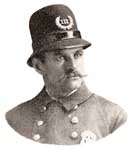 SWAN LINDGREN
Was born in Sweden thirty-five years ago. He early attended the public schools of his native town and became an efficient scholar as well as a musician of more than average excellence. A curtainmaker by trade, he worked at it after coming to St. Paul in 1888, remaining in one position three years. For four years he was an employe at the Minnesota Transfer. During this time he was also making many an extra dollar by exercising his musical skill. He became a member of the force in August, 1898, and was detailed to the Rondo district. He is married and lives at 2277 Ellis st.
DANIEL E. LINDLEY
Is a Pennsylvanian and was born in Pittsburg in 1854. He was educated in the public schools of that city and when sixteen had an attack of "western fever" which resulted in his leaving it. In 1878 he came to St. Paul and subsequently spent twelve years on the plains of Utah, Montana and Wyoming. June 20, 1890, he joined the St. Paul police force and was detailed as jailer of the Prior av. Sub-station. Officer Lindley is highly esteemed in the Midway district for faithful service rendered, and has many friends in St. Anthony Park, where he makes his home at No. 2292 Hampden av.
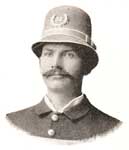 JOHN LINDOU
The policemen of St. Paul have the reputation of being an exceptionally good natured lot of men, and John Lindou is no exception to the rule. One look at his beaming face with its serenely benignant expression, must attest this. He is of Swedish birth and was born in 1865. As a boy he attended the public schools of his native country and when seventeen crossed the ocean to become a farm hand in Goodhue county, Minn. Later he went to work for a Canadian railway company. In 1884 he arrived in St. Paul, only to leave shortly afterward for a coal mine near Des Moines, Ia., where he worked a year. Returning to St. Paul in 1885 he secured a position of private coachman, holding it eight years. Nov. 16, 1892, he was appointed a patrolman, but resigned two years later. Aug. 16, 1896, Mayor Doran reappointed him and assigned him to the Margaret st. Sub-station. He lives at No. 692 Cook st. E.
LEWIS LIVERPOOL
Is a native of Rappahannock, West Virginia, and was born forty-one years ago. June 6, 1896, he was appointed janitor of the Central Station, where he now serves. He was formerly a hackman.
JOHN LYNCH
Was born in Ireland, forty-six years ago. At the age of fourteen he emigrated to Boston and learnt the trade of a bricklayer. Oct. 4, 1880, he was appointed a patrolman and remained at headquarters until transferred to the Margaret Sub-station in May, 1887.
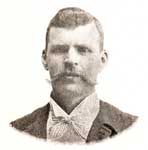 JAMES F. McCORMICK
Patriotism and a love of duty are a heritage with James F. McCormick, whose father was a soldier of the Third regiment and bravely fighting in the civil war at the time of his birth, in 1862. He was born in Philadelphia, and when a child of two years was brought to Faribault, Minn., by his mother. At her death, five years later, he went to live with an uncle at Richland, Minn., receiving his education in the country schools as opportunity permitted. When thirteen he returned to Faribault, joining the National Guards four years later. Upon coming to Minneapolis in 1882 he was permitted to withdraw from the organization. After two years of work in the Mill City he became an employe in a marble works of Faribault. In August, 1886, he came to St. Paul, engaging in bridgework for a period of three years. Later, as a motor-man, in the employ of the Twin City Rapid Transit Co., he pulled the fifth car into Minneapolis on the first electric line. He was employed in this capacity three years, becoming a patrolman Nov. 1, 1892. He is married and lives at No. 447 Sherburne av.
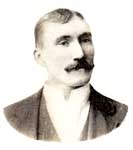 PATRICK McHALE
Was born in Stillwater, Minn., and is thirty-nine years of age. He attended school there and in 1884 came to St. Paul, where he occupied a position as special policeman for eight years. June 21, 1891, he was given a beat to patrol and appointed a regular at the Rondo st. Sub-station. Officer McHale has a splendid record for time served, never having been absent from his post on account of sickness or accident. He is married and lives at No. 530 Fuller St.
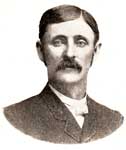 MARTIN L. McINTIRE
The license inspector of St. Paul is Martin L. McIntire, a man who by education and experience is well fitted to perform the duties of that somewhat arduous position. Born in Bloomington, Ill., fifty years ago, he was reared to manhood in the Wesleyan University. Upon leaving school he engaged in the clothing business. At his father's death he took up his occupation, that of a house-mover. Coming to St. Paul in 1885 he became a fuel dealer, three years later resuming the business of house-moving. He was appointed license inspector Aug. 5, 1898. Mr. McIntire is married and a resident of 138 Congress st. E.
JOHN P. McKINLEY
Was born in Iowa in 1863. He was appointed to the force in April, 1889, and is now doing duty as patrolman at the Ducas station.
HENRY MANTEUFFEL
Aged thirty, was born and reared in Benton, Minn. Early in the '80s he came to St. Paul and plied his trade as a carpenter. Subsequently he worked two years as a stationary engineer and was a foreman and inspector of cars for the Chicago, G. W. Ry., for five and a half years. His appointment as patrolman occurred in September, 1896, and in 1898 he was promoted as the West Side member of the Bicycle Police Squad. He is married and lives at 18 Indiana av. E. Mr. Manteuffel is the possessor of a fine police record and has many friends all over the city.
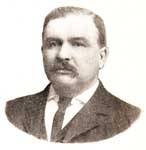 LOUIS L. MARIEN
A pioneer on the force and also of St. Paul is Louis L. Marien, who has been a patrolman eighteen years and a resident of St. Paul since 1856. He was born in Canada and is fifty-one years old. Beginning when a mere boy he worked seventeen years as a river driver of logs, and in June, 1881, became a member of the force. He was then at the Central station, but later on was transferred to the Margaret Sub-station as driver of the patrol wagon. Mr. Marien has always enjoyed remarkable health and after his long service, is still amply able to cope with the rigor of a Minnesota winter. He lives at No. 863 Minnehaha st. E.
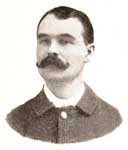 JEROME MARTINEAU
Aged thirty-five, was born in Chicago, Ill., and is of French extraction. At the age of four his parents moved to Spring Lake, Michigan, and there he received a good common-school education. When thirteen he came to St. Paul, working in various capacities for five years. He was a member of the St. Paul Fire Department four and a half years, serving as pipeman of Chemical No. 6. Taking a trip to Washington, be returned shortly and re-enlisted as a fireman. July 21, 1892, he was made a patrolman and given a beat in the Rondo district. He is married and has his home at No. 415 Aurora av.
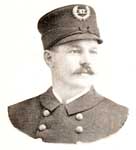 CHARLES MAYER
In the emigration from Prussia twenty years ago, of Charles Mayer, the Fatherland lost one of her ablest sons. He is thirty-eight and has been in St. Paul since 1882, following the trade of a machinist, which he learnt early in life. In December, 1888, he became a patrolman in the Rondo district, where he has since served, being promoted to the bicycle squad a year ago. He is married and resides at 758 Sherburne av.
WM. B. MILLER
Is a German and thirty-nine years of age and is a painter by trade. He was appointed to the department in 1886. In 1894 he resigned and went South. Returning to St. Paul in 1896 he was reappointed to the force and was lately made jailer at the Central Station.
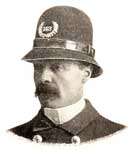 WM. B. MONTBRIAND
Burlington, Vt., is the birth-place of Wm. B. Montbriand, who is thirty-six years of age and a very popular police officer. As a child he attended the public schools of his native city, receiving a very substantial education early in life. In 1887 he came West, as far as St. Paul and engaged in the grocery business there. In 1897 he donned the uniform of a patrolman and was assigned to the Central Station. With the exception of a severe attack of la grippe which confined him to his home for two months, he has never been ill nor has he suffered injury while on duty. The latter fact is all the more remarkable because of the many arrests made daily by Officer Montbriand, some of them dealing with an exceedingly low and desperate class of men and women.
He is a great lover of good horseflesh and in days gone by has been known to handle bronchos, fresh from Western wilds, with surpassing skill. His private opinion though is, once a broncho, always a broncho. Mr. Montbriand belongs to Minnehaha Camp, Modern Woodmen of America. He lives at No. 537 Broadway.
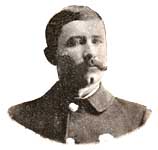 MICHAEL F. MORAN
Was born in Neillsville, Wis., and is thirty-five years old. When seventeen he became a railroader, working successively as switchman, brakeman, yardmaster, and finally as conductor of one of the transcontinental lines. His railroad experience embraces service in every state west of the Mississippi, and has given Officer Moran the aspect of being a traveled man of much native intelligence. His first halt in St. Paul was made in 1887. June 25, 1894, he joined the force and was assigned to the Central station. After three months service he was transferred to the Margaret district, and in 1898 promoted to the Bicycle Police Squad. He is married and lives at No. 692 4th st. E.
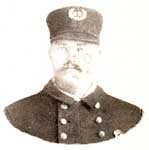 BENJ. FRANKLIN MORSE
Of commanding presence, and keen, resolute mein, backed by a weight which tips the scale at 230 pounds, Benjamin Franklin Morse is an honor to the name be bears as well as to the body of men in which he has cast his lot. He was born and brought up on a farm in Cuyler, Cortlandt county, N. Y., and is forty years of age. When eighteen he came to St. Paul and for three years worked as a locomotive fireman, receiving promotion to the position of engineer at the end of that time. Two years later he resigned and went into the express business. In 1887 he became an engine-driver in the Fire Department, continuing in that position five years. At the end of this period he handed in his resignation in order to join the rank and file of the Police Department. He has always been attached to the Central Station.
Officer Morse has enjoyed uniform good health during the years of his incumbency, and has met with only one accident worth mention. It was while making the arrest of a notorious crook, that his knee was badly sprained as the result of a most desperate encounter. But two weeks of hospital nursing completely restored him. Officer Morse is married and resides on his own property at No. 757 Tuscarora st.
PATRICK E. MURNANE
Was born in Aurora, Ill., and is thirty-seven years of age. He came to St. Paul in 1870, and worked at the trade of a boiler-maker. July 5, 1892, he became a patrolman and was assigned to the Central Station.
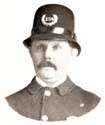 Ex-OFFICER GUSTAV NELSON
There are so few men in average life who tip the scale at two hundred pounds that one cannot help wondering how the St. Paul Police Department managed to secure so many. Gustav Nelson weighs two hundred and twenty-five, is a six-footer. He was born in Sweden and was well educated in the public schools there. Shortly after his arrival in St. Paul, in 1882, when he was a youth of seventeen, he obtained railroad employment, and remained at it four years. Then he worked as a scaler for a wholesale lumber firm thirteen years, and in August, 1898, was given a beat by Mayor Kiefer. He is not a member of the force at present.
He is married and occupies his own property at No. 865 Cook st. E.
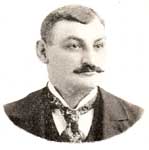 EDWARD NEUMAN
With a record of twenty-three lives rescued from a watery grave there is no reason save his own modest dread of notoriety to prevent Officer Edward Neuman from being known as a modern hero. Born April 6, 1865, in Winona, Minn., he is yet a young man and bids fair to devote many years of the same nerve and endurance which characterized him as an expert swimmer, to the service of the department of which he is now a member. When he was ten years of age, his father, an old settler, who had emigrated to Minnesota from Warsaw, Germany, in t854, removed his family to St. Paul, and engaged in business as a tailor. Young Neuman worked as office-boy for a while and then learned his father's trade, in the meantime going to night school. During his early manhood he worked successively, for a wholesale confectionery firm, a saddlery store and as collector for his brother, Samuel Neuman. All his leisure time was devoted to swimming and he is not only known as the long-distance champion of Minnesota, but also as the amateur long-distance champion of Illinois, holding four medals to that effect. For all his bravery in the saving of life he has received little or no recognition, due chiefly to his extreme reluctance in the matter of acknowledging his own heroism. On Christmas day, 1893, he pulled a man out of the river under the high bridge in St. Paul, and the following September rescued a Montana ranch king out at White Bear lake. He was married to Miss Elizabeth Murray, of Drummond. Wis., in June, 1896, and was appointed a patrolman by Mayor Kiefer March 22, 1899. He lives at 180 Dousman st.
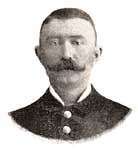 PATRICK E. NEWCOME
What the Central Station would do without genial "Pat" Newcome is hard telling. One can tell his trustiness at sight and his disposition is quite in keeping with his looks. He was born on a farm near Galena, Ill., forty-one years ago. When little over a year old his parents brought him to Fountain, Minn., where he grew up and went to school and settled and married, his wife being Miss Anna Chambers, of Melvina, Wis. In 1889 he came to St. Paul and for awhile was employed in a steam-fitting establishment. He was also a motorman for the street railway company, continuing there until Nov. 10, 1892, when Mayor Wright appointed him a patrolman in the Central district. He has been there ever since.
Officer Newcome's family consists of two sons, Warren and Clarence, aged 9 and 11 years respectively. His residence is located at 156 Pleasant av.
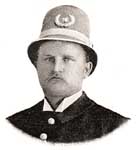 CHARLES NIEMCZYK
Is a German and thirty-six years old. While yet in the Fatherland he learnt the trade of a blacksmith and after coming to St. Paul in 1881 used it to advantage in several long time positions held with the Great Northern, the St. Paul & Duluth Railways and the American Hoist and Derrick Works. He was one of the builders of the large crane used at the World's Fair. July 18, 1895, he became a patrolman and has since walked a beat in the Margaret st. district. He is married and resides at 113½ Acker st. W.
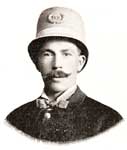 FRANK O. NOREEN
Was born in Sweden on the 13th day of July, 1865. He was a school boy until he was fourteen, but at that age he became a carpenter. The emigration fever early seized him and when twenty-four he installed himself as a farm hand in the neighborhood of St. Peter, Minn. In 1890 he became a car repairer in the N. P. Railway shops of St. Paul, and remained in that position fully eight years. Then he joined the police force with Mayor Kiefer at its head and has since proven himself a thoroughly efficient officer. Mr. Noreen is a member of Arlington Camp, M. W. A., and also belongs to the Swedish Brethren Society. He is a widower and lives with a son and a daughter at No. 618 Whitall st.
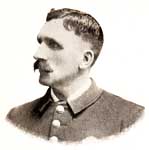 EDWARD E. O'BRIEN
Was a child of four when his parents left Ireland and settled in Goodhue county, Minn. That was in 1862 and during the next ten years he lived the free, uneventful existence common to American country boys, gaining his education whenever opportunity would permit. After that he came to St. Paul and drove a team for a livelihood. Returning to Goodhue county he learnt the miller's trade at Wells Creek and worked at it nine years, subsequently engaging in business for himself, both in the latter place and in Red Wing. In 1888 he came back to St. Paul and spent three years as collector for a local livery firm. He was appointed a patrolman April 14, 1891, and detailed to the Rondo Sub-station.
He is married and a property owner at No. 423 Goodrich ay. His police record is excellent.
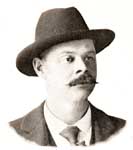 ALEXANDER F. OLBERG
The oldest Scandinavian officer in point of service on the force is Alexander F. Olberg, who has worn his uniform since November, 1886. He was born in Norway and is forty-one years old. When a boy of fifteen he arrived in St. Paul. The following eight years he worked as a machinist and in 1886 became a "blue-coat" of the Central district. May 1, 1887, he was given detective service at the Margaret st. Sub-station and five years later assumed his present post of patrolman in the same district.
Officer Olberg has made many important arrests. He is considered by all who know him as one of the bravest men on duty and together with his family is a highly esteemed resident of the neighborhood in which he lives, 892 Payne av.
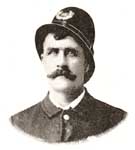 WILLIAM O'NEIL
Is a New Yorker by birth and forty-three years of age. His early home was in Westchester county, and it was there that he went to school. In 1884 he turned his attention westward, locating in St. Paul, where he did general work for a long time. During September, 1892, he was made a policeman and has had a fine roll call record ever since, never having lost time through either sickness or injury. He serves at the Central Station. Officer O'Neil is married and lives at 260 2d st. W.
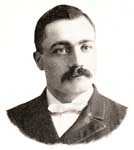 CHARLES J. PALMER
The poet of the St. Paul Police Department is Charles J. Palmer, whose literary versatility has earned him much distinction. He was born in Sweden, April 15, 1863, obtaining a common school education there. In 1884 he emigrated to Minnesota and was for a time employed in general work in St. Paul and Centre City, devoting part of his time to study in the common schools at Centre City and later in a St. Paul business college. In 1888 he was employed by the Minnesota Packing and Provision Co. at South St. Paul, and between 1888 and 1890 he was business manager of the Swedish-American Mercantile Co.'s grocery store on Payne avenue. In 1890 he was appointed an enumerator of the special census; in 1891 became a street car conductor and in 1892 was appointed a patrolman by Mayor Wright, serving on detached duty as acting poundmaster. Resigning in 1894 he became secretary of the Swedish-American Book Company, located on E. 7th st. Two years later he became editor and publisher of a Swedish temperance monthly and was subsequently interested in the publication of a Swedish weekly called "Folkets Nyheter." July 9, 1897, he was reappointed to the police force and assigned to the Rondo st. Sub-station.
Personally Officer Palmer is unassuming and extremely good natured. He is liked by old and young on his beat and greatly admired because of his prompt action in times of danger. On one of these occasions he proved himself truly a hero by rescuing little three-year-old Herbie Schultz from almost certain death. The child was seated in a laundry delivery wagon with a runaway horse going at full speed. The animal was stopped by Officer Palmer at the risk of his own life, and he has since been a prime favorite with Rice st. residents. He lives at 948 Albemarle st. Mr. Palmer is a constant contributor to the press in both verse and prose, and an excellent poem on St. Paul and its police, historical and reminiscent, appears in another portion of this volume.
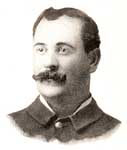 WILLIAM H. PERRO
Fifty years ago Joseph Perro, the father of Officer William H. Perro, was known all over this part of the country as the strongest man of his time. He came to Stillwater, Minn., from Kaskaskia, Ill., in 1844, and from that time until his death, which occurred a few years ago, was never known to find his equal in the matter of physical strength. He was also a man of strong, determined character for whom a whole community mourned at the time of his decease. All these qualities were inherited by his son, so that it is small wonder officer Perro is so highly esteemed by all those with whom he has to deal. He is also a decidedly handsome man, in uniform or without. He was born on a farm near Stillwater, Aug. 20, 1855, and after attending the public schools of that city worked twelve years on his father's dairy. In 1884 he was marshal of South Stillwater. During the spring of 1887 he came to St. Paul and in September of the same year was appointed to the force by Mayor Smith. He has always occupied a beat in the Central district. He lives at 397 10th st. E.
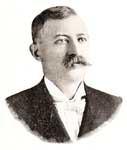 JOHN PETERS
Is a rugged German-American officer of the Midway district. He was born in Europe forty-four years ago, and when a boy of seventeen came to St. Paul. During the years intervening between his arrival and his appointment to the force he worked as a farm hand and a dairyman. In 1888 he became a member of the Prior av. police contingent and is still there. Officer Peters is well liked, both at the station and throughout Merriam Park. He is married and resides at No. 1878 Carroll st.
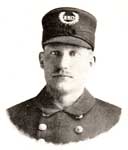 FRANK PETERSON
Among the youthful Swedish guardians of the peace is Frank Peterson, who is twenty-nine years of age, and of foreign birth. When nine years old he was brought to St. Paul and sent to the public schools. Later he worked alternately as a laborer and as a railroad hand, being employed in the Great Northern freight department for some time. Mr. Peterson became a policeman in June, 1897, answering roll call at the Central Station. He lives at No. 690 Olive st.
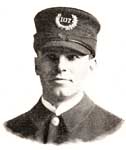 CHARLES B. PICHA
Was appointed a patrolman at the early age of twenty-two years. He, too, is a St. Paul boy, born in 1874, and brought up in the city schools. Prior to joining the force he worked in a wholesale clothing house. His appointment occurred Nov. 7, 1896, and he was detailed to the Central Station. Officer Picha is of an extremely energetic temperament and possesses a cheerful, optimistic turn of mind, which wins him many friends. He lives at 163 Forbes av.
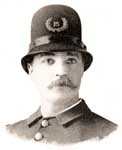 CHRIST PORTER
That brawn and muscle belong almost exclusively to the country boy is amply demonstrated by the fact that two-thirds of the St. Paul police force were at one time country lads. Christ Porter was one from the hour, thirty-six years ago, when he first saw the light of day in a Goodhue county farm house to the time when he decided to leave the little log school and its many associations behind to hunt for pastures new. He was seventeen then and when he came to St. Paul he set in to learn a substantial trade. So it was that for twelve years he made a good living at bricklaying and plastering. In September, 1892, he received an appointment to the force from Mayor Wright and was assigned to the Margaret st. Sub-station.
During the spring of 1894 Officer Porter had his skull fractured while trying to arrest a lot of "drunk and disorderlies." He was confined to his room two weeks as a result, but had the satisfaction of knowing that the crew he had safely landed in the patrol wagon would be justly dealt with.
He lives at No. 784 Wells st.
PATRICK POWERS
Officer Patrick Powers, aged forty, was born in Allamakee county, Iowa. He came to St. Paul in 1885 and worked as a lumberman until appointed a member of the mounted patrol April 10, 1889. He was then assigned to the Midway district and subsequently held the position of poundmaster there for one year. Officer Powers met with a singular accident not long ago. To be exact, it was on the 20th of last May. Mrs. Powers was brushing his clothes, preparatory to his going on duty when a revolver at his side exploded, injuring his ankle. He is a general favorite out at Midway and has a wide circle of friends in the city. He resides at No. 2019 Grand av.
WALTER RASMUSSEN
Was born in Denmark and is thirty-eight years old. He was appointed to the force Sept. 30, 1883, and assigned to the Ducas st. Sub-station.
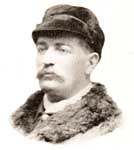 MICHAEL J. REILLY
Is a native of Washington, D. C., and forty-one years of age. When a year old child his parents came to St. Paul and he passed his boyhood going to the Christian Brothers' school. His school days over, he learnt the trade of a carriage painter and worked for Quinby & Hallowell. On leaving his position there he became a car painter for the Great Northern, remaining nine-years. In 1889 Mayor Smith appointed him to the force and he has served at the Rondo Sub-station ever since.
Officer Reilly possesses unusually, good health and strength of muscle. He has never been ill or lost any time through injury received while on duty. He owns his home at 392 Thomas st.
GEORGE J. REINHARDT
Ex-Officer George J. Reinhardt was born in St. Paul and is thirty-six years old. He obtained his education in the Baldwin and Jefferson schools of that city and when eighteen set out to learn the trade of a cigar-maker, remaining at it until he was appointed a patrolman by Mayor Kiefer in July, 1897. Officer Reinhardt is well known throughout St. Paul as a thrifty, law-abiding citizen, a property owner and a man of many agreeable qualities. He is not a member of the force at present. He lives at No. 731½ Martin st.
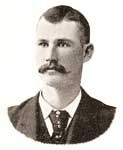 BERNARD F. RYAN
There are four Ryans in the police force and two of them, James and Bernard, are brothers. Bernard F. is the youngest. He is thirty-four years of age and was born in Eagantown, Minn. His childhood was spent on a farm and when fifteen he came to St. Paul. There he drove a team for about six years and during four more was employed by the St. Paul Cable Railway. He was appointed to the force in 1893 and resigned four years later. His reappointment occurred in December, 1897. He has always been enrolled at the Central Station, and though comparatively short his record is nevertheless a very good one. He lives at No. 145 11th st.
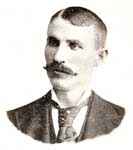 JAMES RYAN
Is thirty-five years old and he patrols one of the Rondo districts. He was born on a farm in Dakota county, Minn., and after learning life's first lessons in a district school, came to St. Paul in 1881. He worked as a motorman some seven years and as a teamster three. Then he joined the police force in 1892 and was given a beat in the Rondo district, where he is still serving. He is well known to the citizens of his precinct as an officer of steady habits and unvarying fidelity to duty. He resides at No. 406 Virginia av.
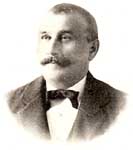 JOHN RYAN
Twenty-six years of service in both the fire and police departments is the record written beneath John Ryan's name at headquarters. Twenty-six years of such service as he may well be proud of, for the record is a splendid one. He was born in Ireland in 1853 and when ten years old was brought to St. Paul. There he was sent to school, and later worked as a teamster. When nearly twenty he became a fireman, serving until the spring of 1886, over thirteen years. That year he became a policeman and received his star as a patrolman of the Central district. In 1887 he was promoted as a driver of the Central patrol wagon, being transferred to the Rondo Station in 1892. He is doing patrol duty there now and is to all appearances just as hale and hearty as he was a dozen years ago. Throughout his long police service he has never lost time by sickness or injury, but once while in the fire department he was injured in a runaway, a fall to the ground splintering his right wrist and laying him up five weeks.
He lives at No. 316 Western av. N.
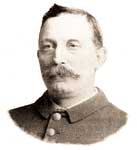 FRED A. RYDER
Another Sandow of the force is Fred A. Ryder, of the West Side patrol, who measures five feet eleven and carries a weight of 225 pounds with perfect ease. He was born in Milwaukee, Wis., in 1862, and went to school in the parochial schools of that city. After that he became a clerk in a wholesale grocery house and remained there until he was twenty-one years of age. In 1883 he came to join his parents in St. Paul, they having preceded him by several years. Going to work as a teamster for a wholesale wood and coal firm he remained three years and then became a foreman for a wholesale lumber firm, being employed in this capacity until his appointment by Mayor Doran, Feb. 14, 1893, to the Margaret st. Sub-station.
He staid there only about four months, assuming his present position at the end of that time. Late in November of last year Officer Ryder received a serious wound at the hands of a desperate character whom he found prowling around the alleys of the business district included in his beat. Though shot through the leg he did not waver until he had locked the fellow up. A ten months' workhouse sentence was imposed, and the officer had to keep his bed four weeks. He resides at No. 317 Prescott st.
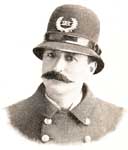 HENRY C. SALVERDA
Was born in Milwaukee, Wis., and is thirty-three years of age. He came to St. Paul in 1883 and for fifteen years worked alternately as a well driller and a tinsmith. In 1898 he was given a beat and assigned to the Central Station. At his own request he was shortly after transferred to the Rondo district. He is now one of the bicycle police and is generally regarded as a very trustworthy, efficient officer. He lives on Langtry av., near South st.
DWIGHT J. SAINTONG
There is one man on the force at whose approach all women who prefer pet poodles to children turn pale and clutch first poodle, then purse. It is none other than the dog license inspector, and his name is Dwight J. Saintong. He was born in St. Paul, Minn., and he is thirty-three years old. Previous to becoming a patrolman he worked nine years as a money delivery clerk for the United States Express Co., and later was with the street railway company of St. Paul three years. His appointment occurred Aug. 9, 1896, and he was a patrolman until Aug. 16, 1898, when he was given his present position. He lives at No. 727 Martin st.
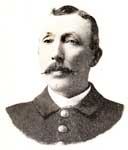 MICHAEL SCANNELL
Aged forty-four, was born in Abbeyfeale, County Limerick, Ireland, and educated in the schools there. In early manhood he left the Emerald Isle and came to this country, reaching St. Paul in 1885. For two years he worked in the freight department of the Great Northern shops and then in 1887 became a patrolman at the Margaret Station. Sept. 18, 1896, he was transferred to the Central district, where he is at present. Officer Scannell is generally liked by all who meet him as well as by his colleagues and superiors in command.
ERNEST L. SCHILLING
Is a native of Washington Co., Minn., and thirty-nine years old. In 1885 he located in St. Paul, and for a time held a position in the state capitol. He was also a street car employe. Nov. 17, 1892 he was appointed a patrolman in the Central district, and two years later transferred to the Rondo St. Sub-station.
MICHAEL Z. SCHORN
The driver of the work-house van, Michael Z. Schorn, is thirty-seven years of age and a St. Paulite by birth. Before entering the police force he was successively a carpenter, a locomotive fireman and a grocer.
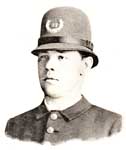 OSCAR SKOOG
Officer Oscar Skoog thinks the club is mightier than the pen, and thereby pays the club a handsome compliment for his pen has certainly never been aught but a power in his hands. He was born in Sweden Dec. 14, 1866, but coming to St. Paul as a child of two, has very little recollection of any other home. When he had completed his education in the public schools he learnt the trade of a tailor, but left it to become a designer and illustrator. Some of his pen and ink sketches have been pronounced by critics to be exceedingly well done and he has received favorable mention in a number of art journals. He deserted the pen for the club in 1893 when he was given duty at the Margaret St. substation. In 1896 he resigned and resumed his sketching. A year after, however, he was re-appointed to the Central station. He lives at No. 485 Hopkins st.
GEORGE W. SMITH
Dubuque, Iowa, is the birth-place of George W. Smith and he is forty-one years of age. In 1882 he came to St. Paul and worked at his trade as a horse-shoer. In the spring of 1886 he was made a policeman and assigned to the Central Station. Ten years later he was transferred to his present post in the Rondo district.
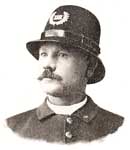 PATRICK R. SMITH
Forty years ago, when West 7th St. in St. Paul was acreage, Patrick R. Smith was born in a little house on the corner of W. 7th and Montreal av. With few exceptions he has lived there ever since, the little house having given way to a more substantial structure. When a boy he lived the life of a farmer and later on drove a team for the garrison at Fort Snelling. After three years of the latter work he started a retail liquor business, continuing at it six years. He then became a conductor for the Twin City Rapid Transit Co., holding this position three years. Nov. 13, 1894, he joined the police force and was assigned to the Central Station. Officer Smith has enjoyed remarkable health throughout his period of service, never having lest time through sickness or accident.
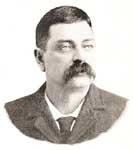 WILLIAM W. SMITH
Is a West Virginian, aged forty-five years. He was born and brought up in Wheeling, coming to St. Paul in 1882. For ten years he followed railroading, then in June, 1892, he became a policeman and was given a beat in the Central district. Two years later he resigned, going into the retail liquor business. His re-appointment occurred in June, 1896 and he was for a time a patrolman in West St. Paul but was transferred to the Central Station the same year. Like almost all Southerners Officer Smith is of a hearty disposition; enjoys a good joke in or out of season and is very popular among his fellows. He lives at No. 559 De Soto st.
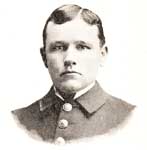 EX-OFFICER JOHN F. SPEAKMAN
Was born in St. Paul twenty-nine years ago. Like many other bright, capable boys, he completed his education by learning a trade, and at the age of twelve was busily mastering the intricate rules employed by engineers and machinists. He followed the latter occupation sixteen years and then donned the star and buttons of a "copper," over on the West Side. This, was in September, 1898 and two months later he was transferred to the Central Station. He resides at No. 94 Robert st. S. He has resigned from the force since the above was written.
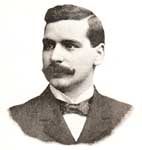 WILLIAM H. SPRINGER
There are comparatively few "yankees" on the force, but the few who do represent New England are decidedly a credit both to themselves and to their native states. Wm. H. Springer was born in Bangor, Me., and is twenty-eight years of age. He came to St. Paul when a child of five and was brought up in the local public schools. Attaining manhood, he worked as a brick-layer, devoting "between times" to the study of music, of which he is very fond; so much so that he has become very proficient in the art. He was appointed a patrolman in June, 1896, and assigned to the Rondo district. Officer Springer was given a wheel to ride as one of the "squad" in 1898. He lives at No. 760 Rondo st.
JACOB STADFIELD
May rightly be called a pioneer of St. Paul, for he was born there forty-one years ago and has since been identified with many branches of city service. From 1869 to 1876 he worked as general delivery clerk in the St. Paul post-office and for four years was employed in the St. Paul custom house, port of St. Paul. He was appointed a patrolman and detailed as jailer of the Central station, June 14, 1896. In May, 1898 he was delegated to his present post as jailer of the Ducas st. Sub-station. He lives at No. 317 Wabasha st.
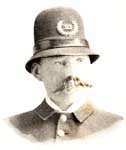 AUGUST H. STONE
Is a native of Sweden, and twenty-nine years old. He came to St. Paul when a youth of sixteen and went to a business college in Minneapolis. Later he worked for a St. Paul commission house, and invariably proved himself a careful, capable business man. Oct. 22, 1896, he was given the right to wear a city "blue coat" and has since faithfully walked a beat in the Margaret district. He lives at No. 694 Cook St. E.
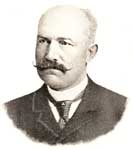 ALBERT STOTZ
The interest that always centers in the oldest veteran of any service is not phenomenal; it is a natural tribute to the valor and fidelity of a lifetime. So when it is said that Albert Stott has been a patrolman seventeen years, the fact that this is the longest term of patrol service must be added, together with unstinted praise for the record he has won. He is not a veteran in years; only forty-eight, and a German by birth and education. In 1880 he arrived in St. Paul and forthwith located as a carpenter, working in that capacity until appointed to the force in 1882. At that time there was but one police station in St. Paul, but with the opening of the Rondo Substation, a few years later, he was transferred there. He lives at No. 309 Carroll St.
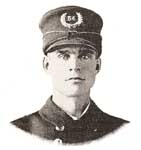 CARL E. SWANSON
Is the youngest active patrolman on the force. That is to say he walks a beat just like an old-timer, and if need be wields his club with all the valor usually born of long experience. He is twenty-four and a native of Scott Co., Minn. When five years old he came to St. Paul with his parents and went to school in that city. Afterward he worked as a laborer, driving a team for four years. Dec. 14, 1898, he was appointed a patrolman and assigned to the Margaret St. Substation. He lives at No. 1007 Greenbrier av.
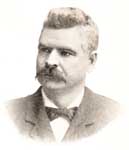 MICHAEL F. SWEENEY
Of Detective Michael F. Sweeney it can truly be said that his deeds speak louder than his words. Were it not that a knowledge of his ability is common property it would be impossible to do him the justice he deserves. Shrewd and alert, he has, to say the least, never failed in the performance of duty and his services are valued accordingly by his superiors in office. Mr. Sweeney was born on a farm in Dakota County, October 19, 1858. The first eighteen years of his life were spent alternately in doing chores and going to district school. Coming to St. Paul he was for six years an employe of a produce commission firm. Then he engaged in business for himself as a railroad contractor and real estate dealer. Jan. 7, 1892, he was appointed a patrolman and in May, 1894, a detective. His chief relaxation is hunting, of which he is very fond, going to North Dakota every year during the game season. He lives at No. 344 Martin st.
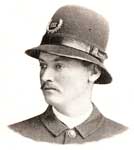 AUGUST B. SWENSON
Was born in Sweden. He is thirty-five years old. As a child he attended the elementary schools of his native land and when sixteen came to St. Paul. Shortly after he went to work as a coachman and when he had become thoroughly accustomed to the manners and customs of this country, set to work as do almost all the bright young Scandinavians who come here, to better his condition in life. Two years he clerked in a dry-goods store and later engaged in a cigar and confectionery business. He joined the force May 1, 1887 and served eight and one half years at the Margaret St. Sub-station, tendering his resignation at the end of that time. June 4, 1896, he was re-appointed and assigned to the Margaret district, from which he was transferred to the Central Station in March, 1897. He is a member of the bicycle squad. He resides at No. 927 Sims st.
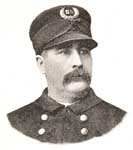 JOHN TALTY
Is aged forty and was born in Wyoming county, N. Y. He came to St. Paul in 1879, and plied his trade as a blacksmith five years, and a little over. Then he worked as a brakeman on one of the transcontinental lines for four years. In September, 1886, he was appointed a patrolman and has since been one of the Central "regulars." Officer Talty is a man of fine physique and great hardiness. Throughout his thirteen years of service he has never lost time because of sickness or injury. He resides at No. 943 Tuscarora st.
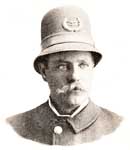 JOHN W. THELIN
Alert and energetic, and possessing a strength which will brook no defiance John W. Thelin may well feel that he is admirably fitted for his post. Born in Sweden thirty-two years ago, he came to this country when a lad of fifteen, making St. Paul his home, and driving a team for a living. When he became a man he worked in the freight department out at the Minnesota Transfer. Feb. 28, 1898, he put on the conventional navy blue of office, and was assigned to the Rondo Sub-station. Later he was transferred to his present beat in the Central district. He lives at No. 661 Burr st.
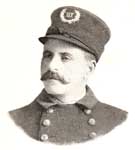 THOMAS W. TOWEY
Is sometimes known as the "plucky little Midway buttons," and in the matter of valor and doughty perseverance he certainly has won an enviable record. He is a native of County Mayo, Ireland, and thirty-eight years of age. In 1880 he emigrated to Rhode Island, and for a short time worked at the trade of a foundry-man, which he had learnt in the old country. The same year he came to St. Paul and for two years was employed as yard man by the C., M. & St. P. Railway, subsequently becoming a check clerk for the Minnesota Transfer Railway. He remained in the latter position three years, then changed it to become a special policeman for the same company. After seven years of service he was appointed a mounted police officer, Oct. 3, 1892, and has been ranging the Midway district ever since.
Officer Towey is very popular at the annual State Fair, to which he has several times been assigned by request of the managers. He has had two accidents while on duty, one in 1892, when his horse slipped and caused him to break his ankle, and the other a year ago when his life was threatened by a collision with a runaway. He resides at No. 2146 University av.
JOSEPH F. TROY
Was born in St. Paul June 29, 1864. He was formerly a steam fitter and a car repairer. Aug. 10, 1896, he was appointed a patrolman by Mayor Doran and assigned to the Rondo st. Substation. Shortly after he was transferred to the Margaret station, where he is at present.
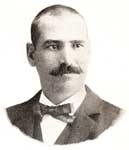 EX-OFFICER MATHIAS J. TSCHIDA
Was at one time a very efficient member of the force. But patrolling a beat seemed hardly compatible with his trade as a worker in tin and he left his post after a year's service to become first cutter for Horne & Danz. Mr. Tschida was born in Illmitz, Hungaria, Sept. 19, 1869, and attended school until twelve years of age. Then he studied at Kapuvar for a year and in 1884 came to America.
During his year of police duty, which began in 1895, and ended June 21. 1896, he made some very important arrests, those of Link Thayer, sent up for twenty years, and Jack Slattery, now at the reformatory, being specially remembered as instances of Officer Tschida's fearlessness and intrepidity.
He was married on July 3, 1893, to Miss Caroline Reiling, of St. Paul, and their neat little home at 976 Matilda st. is quite complete in the possession of four little ones. Mr. Tschida is a member of C. O. F. No. 510 and St. Bernard's Benevolent Society.
MICHAEL TSCHIDA
Is a Hungarian and forty-one years of age. June 3, 1890, Mr. Tschida was given the position of jailer at the Rondo st. Sub-station, and after that was twice transferred; first to the Margaret district, and then to his present beat in the Central district.
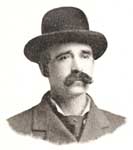 WILLIAM F. TWOHY
A genial, hearty patrolman is William F. Twohy, a "hale good fellow well met" in every sense of the word, and liked by young and old. Born in Williamsport, Pa., on the 2d of Feb., 1865, he attended a parochial school until he was twelve years old. On coming to St. Paul in 1877, he was an academy student for three years and then learnt the trade of a boiler-maker in Minneapolis. He pursued this calling for eight subsequent winters, working as a roll-tender in the saw-mills during the summer season. With the exception of six months' stay in Grand Forks, N. D., he continued at boiler making until his appointment to the police department July 1, 1890, spending the last two years in the Great Northern shops in St. Paul. He has always walked a beat in the Central district, and be it given for weal or woe, will never be forgotten by those whose hands he has clasped in his vice-like grip. And being unmarried it stand to reason that ladies are included.
Officer Twohy is a member of St. Paul Court No. 17, I. O. O. F., and of Capital Lodge, No. 51, Knights of Pythias.
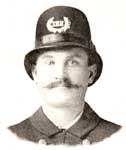 MICHAEL URBANSKI
The sturdy Teutonic race has always been a credit and a source of strength to whichever state it has made its own by adoption, and Michael Urbanski is today as devoted to the performance of his mounted patrol duty as he was years ago to the not less exacting routine of "soldaten-leben" in the First regiment, Ulan Cavalry. He was born in Prussia and is thirty-seven years old. Before coming to this country he served five years in the German army, the last two being as a corporal. Soon after locating in St. Paul in 1887 he went to work for the People's Ice Co., remaining six years. After that he was employed in a wheel factory. Sept. 17, 1895, he joined the police department and was assigned to the Margaret district, in which he is a property holder. He lives at No. 990 Jessamine st. E.
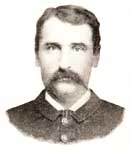 CHARLES I. VONTRAT
Of a dignified, though kindly mien, and an erect military carriage, Charles I. Vontrat invariably impresses even casual observers as being one of the most careful, conservative police officers on the force. He is forty-four years of age and of German birth. In 1883 he came to St. Paul and engaged as a packer in a wholesale crockery store, remaining two years. July 13, 1885, he was appointed to the force, and walked a beat in the Central district until the opening of the Margaret Sub-station in 1887, when he was assigned there. Dec. 16, 1898, he was promoted to the position of mounted officer for the same station.
Last November, while engaged in stopping a runaway horse hitched to a cutter, Officer Vontrat received a fractured arm as the result of a kick from the horse. He lives at No. 1026 Reaney st.
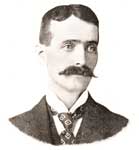 GEORGE W. WELLS
Is a native of Detroit, Mich., and thirty-five years of age. As a child he received a very good education in the public schools of Detroit, but did not finish, preferring the out-of-door exercise of railroad life to the hum-drum routine of a school-room. He was for years alternately a locomotive fireman and an engineer. His first visit to St. Paul was in 1884. June 6, 1896, he was appointed a detective at the Central Station and has since then proven himself extremely well adapted to the work.
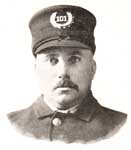 ALBERT J. WENDT
Was born in Germany and is thirty-six years of age. As a child he attended the public schools of his native land and on attaining manhood entered the German merchant marine service. In 1885 he came to St. Paul and worked at contracting and carpenter work. In October, 1895, he was appointed patrolman for the Salvage Corps, and after holding the position over two years he resigned to enter the police department Feb. 11, 1898. Mr. Wendt has with only a year of service already proven himself a very efficient officer, skilled alike in the handling of a simple "drunk" or a hardened criminal. He lives at No. 221 Norris st.
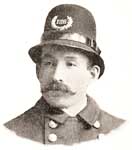 JAMES WHITE
Was born in bonny Scotland thirty-three years ago, and though he has been in this country a long time he still retains the winning frankness and blunt good nature characteristic of his race. He came to St. Paul in 1888 and for six years prior to joining the force worked as janitor of the Manhattan Building. His appointment as a patrolman occurred March 8, 1898, and he was assigned to the Central Station. Within a year's time Officer White has never missed the daily roll call there. He is married and has one child. He lives at No. 205 University av. E.
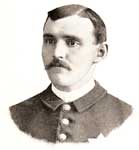 HANS S. WILLIAMS
When Hans S. Williams concluded to leave Denmark in 1880 the little kingdom lost one of her bravest citizens and a youth whose strength it could illy afford to spare. He is thirty-nine now, and stronger than ever, weighing two hundred and ten pounds and enjoying perfect health. In 1880 he located in New Jersey, working as fireman in a terra-cotta factory. A year after he reached St. Paul, but left it to become a traveler through Wisconsin, Michigan and Missouri, engaging as a steamboat hand while in the latter state. Upon his return to St. Paul in 1882 he became an employe of the Canadian Pacific Railway and later on a driver for the Hamm Brewing Co. He received his position as a policeman May 1, 1887, and was promoted to the rank of mounted patrolman in 1889. He has always served in the Margaret district. With the exception of an accident in which he was shot through the left leg he has never been off duty on account of illness. He resides at No. 962 Reaney St.
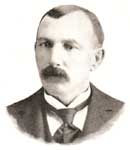 MATHIAS YOUNG
Was born in Germany in 1851 and died April 29, 1899. He was a territorial pioneer, for he came to St. Paul in 1857 when he was a child of six. He was born in Germany, but receiving his education in St. Paul had little recollection of any other home. Early in life he learnt the trade of a cook and worked in that capacity for river steamboats eighteen years. Later he owned an express and baggage line in St. Paul, doing a good business for three years. July 2, 1884, he received his appointment to the Central Station, and with the opening of the Rondo st. Sub-station in 1887, was transferred there. During his fifteen years of service Officer Young had won not only an excellent record, but the esteem of all who knew him. His widow, Mrs. Margaret Young, lives at No. 21 Magnolia st. E.
ALBERT J. ZACHER
Was born in Bohemia in 1864. He was appointed to the force Oct. 18, 1892, and is now doing duty as patrolman at the Central Station.
GUSTAV A. ZIMMERMANN
The last appointment to the force was born in Galena, Ill., July 20, 1868. He was appointed Oct. 9, 1899, and assigned to the Central Station. He was formerly a grocery clerk.
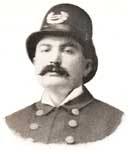 MOSES ZIMMERMAN
Russia's sole representative on the force is Moses Zimmerman, who is thirty-five years old and a man of robust build and marvelous strength of arm. He came to St. Paul in 1882 working for the Western Fence Co. for four years, as a clerk in a clothing store for five years and for four years he was in the wholesale fruit business for himself. In October, 1894, he was appointed to the police force and assigned to the Central Station, soon after being transferred to the one in West St. Paul. Officer Zimmerman has won not only an excellent record, but the good will of all who know him, and for faithful adherence to duty.
He lives at No. 2 Chicago av. W.
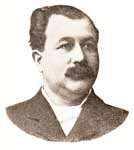 JOSEPH KING
One of the most important "sub" departments of the St. Paul Police department is that of the Police Patrol Telegraph, located at the Central Station. Superintendent Joseph King is at its head, and as a skilled electrician of many years experience, is eminently well fitted for the position. He was born in Providence, R. I., forty years ago, and early in life became a stationary engineer. Pursuing this avocation eight years, he worked the succeeding eleven as an expert for the Massachusetts General Electric Co., of Boston, traveling through the New England states the greater part of the time. In 1893 he was superintendent of an electric plant in Oshkosh, Wis. Coming to St. Paul in 1894 he became an electrician at the Wood Harvester Works. On March 10, 1897, he stepped into his present position. He lives at 97 Hoffman av.
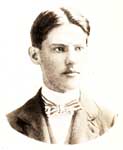 ALBERT EKMAN
Is the son of John S. Ekman, once a prominent contractor, but now retired from business. He is also a son of St. Paul, born in the city on Sept. 22, 1879, and until within the last few years a scholar in the city schools. On leaving school he became a drug clerk and on Aug. 1, 1899, received his present position as telephone operator in the office of Supt. King. Mr. Ekman is the fourth of a family of five boys, and both at school and at business has been known as an extremely bright young man, possessed of pluck and energy enough to carry him safely through the world. He lives at No. 826 Iglehart st.
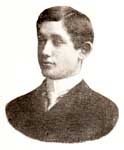 JOSEPH W. MITCHELL
One of the newly installed operators in the Police Patrol Telegraph department is a Yankee by birth, but a Gopher by bringing up. He is only nineteen years of age, having been born in Worcester, Mass., May 13, 1880. Four years later his parents removed to St. Paul, where his father became a member of the old volunteer fire department, and subsequently of the present one, being still in service as the engineer of Engine Company No. 5. Young Mitchell graduated from the Central High School, and his first employment was in his present position, which was given him by Supt. King Aug. 1, 1899. He is an only son, and needless to remark, a very clever young man, destined to attain success in a future which is now opening up so brightly. He lives at No. 531 Selby av.
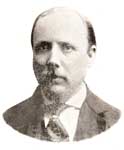 ORNEY J. KNUTSON
Is a native of Norway and a bright young electrician of whom his many countrymen may well be proud. He is thirty-two years of age, married, and the father of three bouncing boys. Twenty years ago he went to work as a messenger boy for the St. Paul Messenger Co., and with the lapse of time became an operator there. Later he worked eighteen months as electrician for the N. P. Railway, and in 1893 was made night manager of the A. D. T. Co. May 6, 1895 he received his position as operator in the Police Patrol Telegraph Department. He lives at No. 537 Woodward av. Since the above was written he has resigned his position.
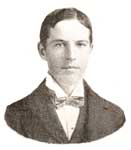 ROY L. KEITH
The lineman of the Police Patrol at the Central Station, Roy L. Keith, enjoys the unique distinction of being one of the youngest members of the force. He is only nineteen years of age and Peoria, Ill., is his birthplace. Previous to his appointment by Mayor Kiefer, in Dec. 1898, he worked a year and a half as repairer of telephones for the N. W. Electrical Engineering Co., of St. Paul. He lives at No. 957 Ashland av.
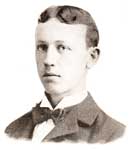 JOHN H. TUBBESING
Only twenty-four and absolutely in love with his work; in love with life, too, as a natural consequence. Such is John H. Tubbesing, who operates the Police Patrol Telegraph up at the Central Station. He was born in St. Paul and went to school until he was seventeen. After that he drifted from one trade to another for a few years and in 1895 took his brother's place as a Central Station electrician. He lives at No. 447 Martin st.
Since the above lines were written Mr. Tubbesing resigned his position to accept a more lucrative one and at the same time a more healthful one for him with the Northwestern Telephone Exchange Co.
SALARIES OF OFFICERS AND EMPLOYES OF THE DEPARTMENT
| Per Year | |
| Chief of police | $2,412.50 |
| Chief of Detectives | 1,930.00 |
| Secretary | 965.00 |
| Captains | 1,254.50 |
| Lieutenants | 1,06150 |
| Mounted lieutenants | 1,321.50 |
| Sergeants | 868.50 |
| Mounted sergeants | 1,128.50 |
| Detectives | 1,158.00 |
| Patrolmen | 840.00 |
| Bicycle patrolmen | 880.00 |
| Mounted patrolmen | 1,100.00 |
| Driver of workhouse van | 965.00 |
| License inspector | 1,061.50 |
| Matron | 600.00 |
| Janitor | 600.00 |
| Poundmaster | 600 00 |
| Supt. of police patrol and all his help |
3,200.00 |